The beats of the canter: how it works, leads and counter-canter
The canter is the only one of the three gaits that comes in two versions: on the right lead and on the left lead. Knowing its three beats and the order in which the legs land means telling the lead from the ground and in the saddle, striking off correctly, and understanding what a disunited canter and counter-canter are.
A three-beat gait, asymmetrical and rocking
The canter is a bounding gait in 3 beats, followed by a moment of suspension when no foot touches the ground. It is an asymmetrical gait: the right and left sides do not work in the same way, hence two canters. And it is a rocking gait: the forehand and the hindquarters rise and fall in turn, like a seesaw.
- Right canter
- The horse canters “on the right leg”: the off fore and the off hind land ahead of their partners on the left. The off fore lands last.
- Left canter
- The reverse: the left legs land ahead, and the near fore lands last.
- True canter
- Cantering right on a right-hand curve and left on a left-hand curve: being on the correct lead, where the horse is balanced.
The order of footfalls: the three beats of the canter
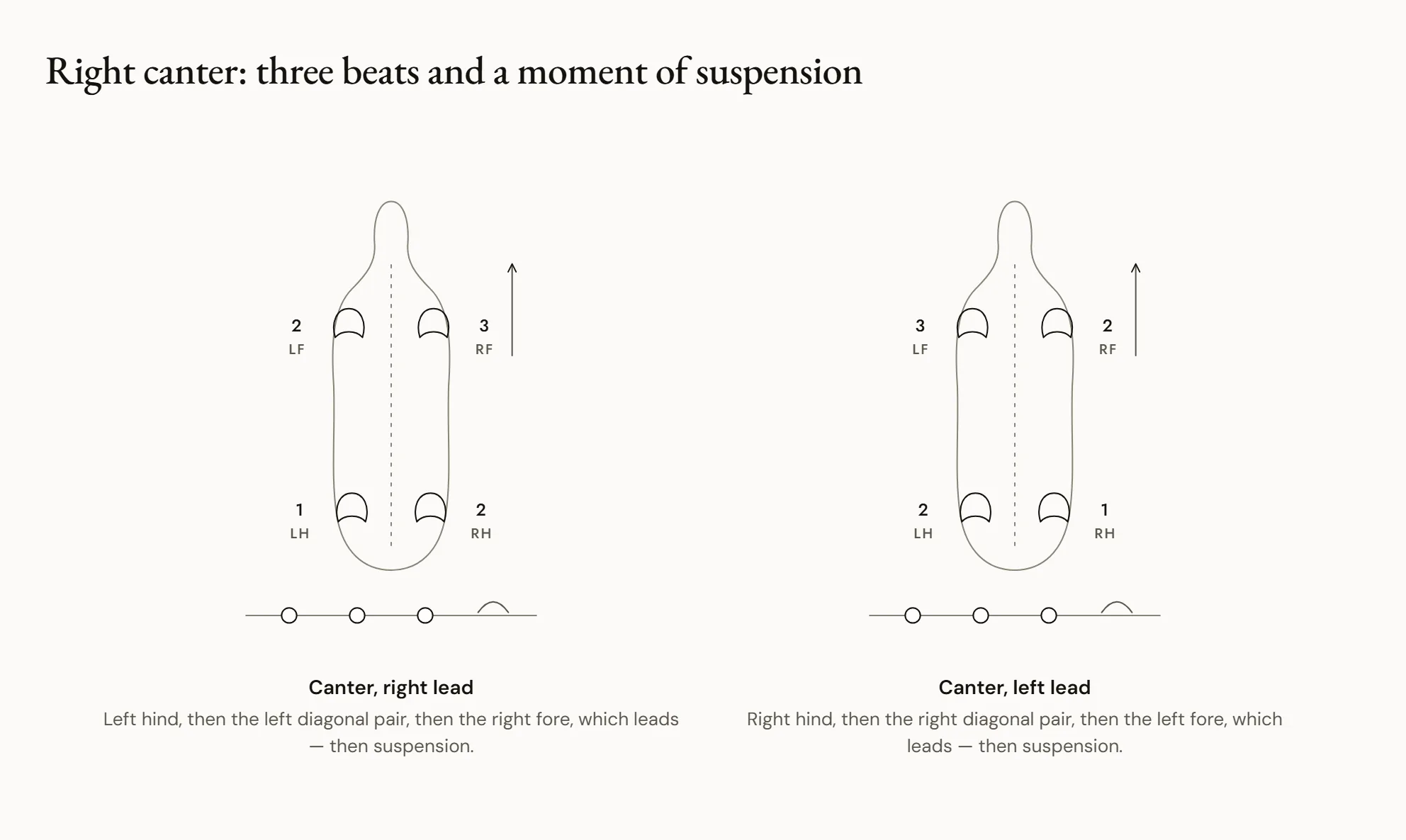
| Beat | Right canter | Left canter |
|---|---|---|
| 1st beat | Near (left) hind | Off (right) hind |
| 2nd beat | Left diagonal: off hind and near fore together | Right diagonal: near hind and off fore together |
| 3rd beat | Off (right) fore | Near (left) fore |
| Suspension | No foot on the ground | No foot on the ground |
Remember
Right canter starts with the near hind and ends with the off fore. The canter takes its name from the foreleg that lands last, furthest forward: the leading leg.
Telling the lead, from the ground and in the saddle
- From the ground: watch the forelegs. The one that reaches furthest forward at each stride gives the canter its name.
- In the saddle, with your eyes: without tipping your upper body, lower your gaze to the shoulders. In right canter, the right shoulder comes further forward.
- In the saddle, by feel: in right canter your pelvis is carried from back to front and slightly from left to right. With practice you feel the lead without looking.
Tip
Train your eye from the side of the arena: call “right” or “left” for every horse that canters past, then check with the rider.
A word from the instructor
To check the lead, lower your eyes, not your shoulders. A rider hanging over the shoulder for “a better look” mostly stands an excellent chance of persuading the horse to change leg.
Striking off on the correct lead: the diagonal aids
They are called diagonal aids because the two main aids come from opposite sides: the inside rein and the outside leg. To strike off on the right lead, prepare the strike-off on a right-hand curve.
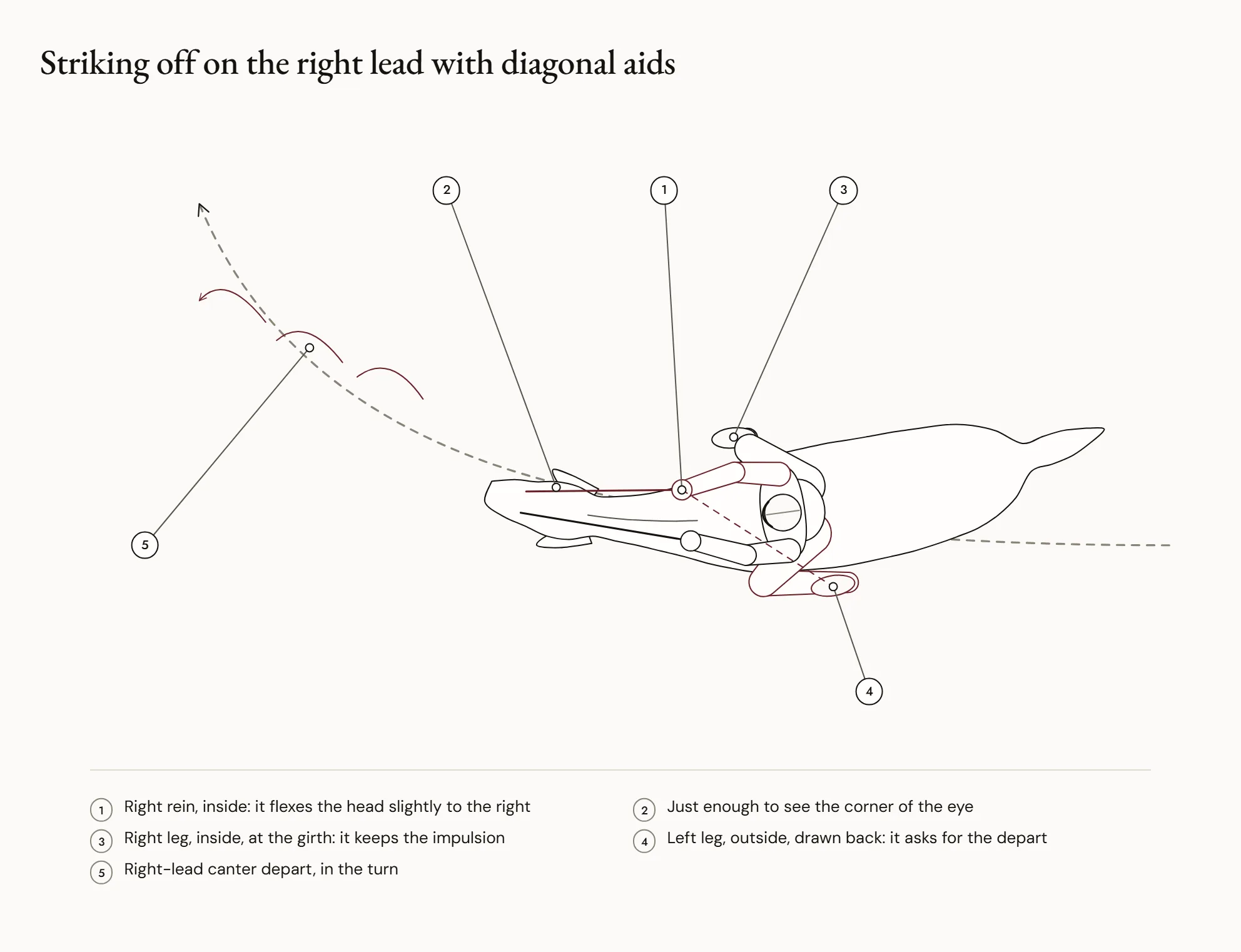
- Prepare the gaitIn sitting trot or an active walk, get a regular gait, in a corner or on a circle.
- Position the headWith the right rein, turn the head very slightly to the right; the left rein keeps the contact.
- Place your legsDraw your left leg, the outside one, back behind the girth; your right leg stays on the girth.
- AskGive a clear aid with the left leg, backed up by the right, staying tall and seated.
- Yield and followSoften your fingers slightly, let your pelvis follow and look ahead along your line.
Remember
Right lead: right rein, left leg. Left lead: left rein, right leg. The inside rein positions, the outside leg asks for canter, the inside leg keeps up the impulsion.
Common mistake
Leaning forward or to the inside as you ask, or pushing the horse into a faster and faster trot: it rushes and often strikes off on the wrong lead.
Disunited canter and counter-canter
If the forelegs canter on one lead and the hind legs on the other, the horse is disunited: the gait turns jerky and it loses its balance. Come back to trot and strike off again. Cantering on the outside lead by mistake is the wrong lead. But asked for on purpose, it becomes an exercise: the counter-canter, long called galop à faux, the “false canter”, in French.
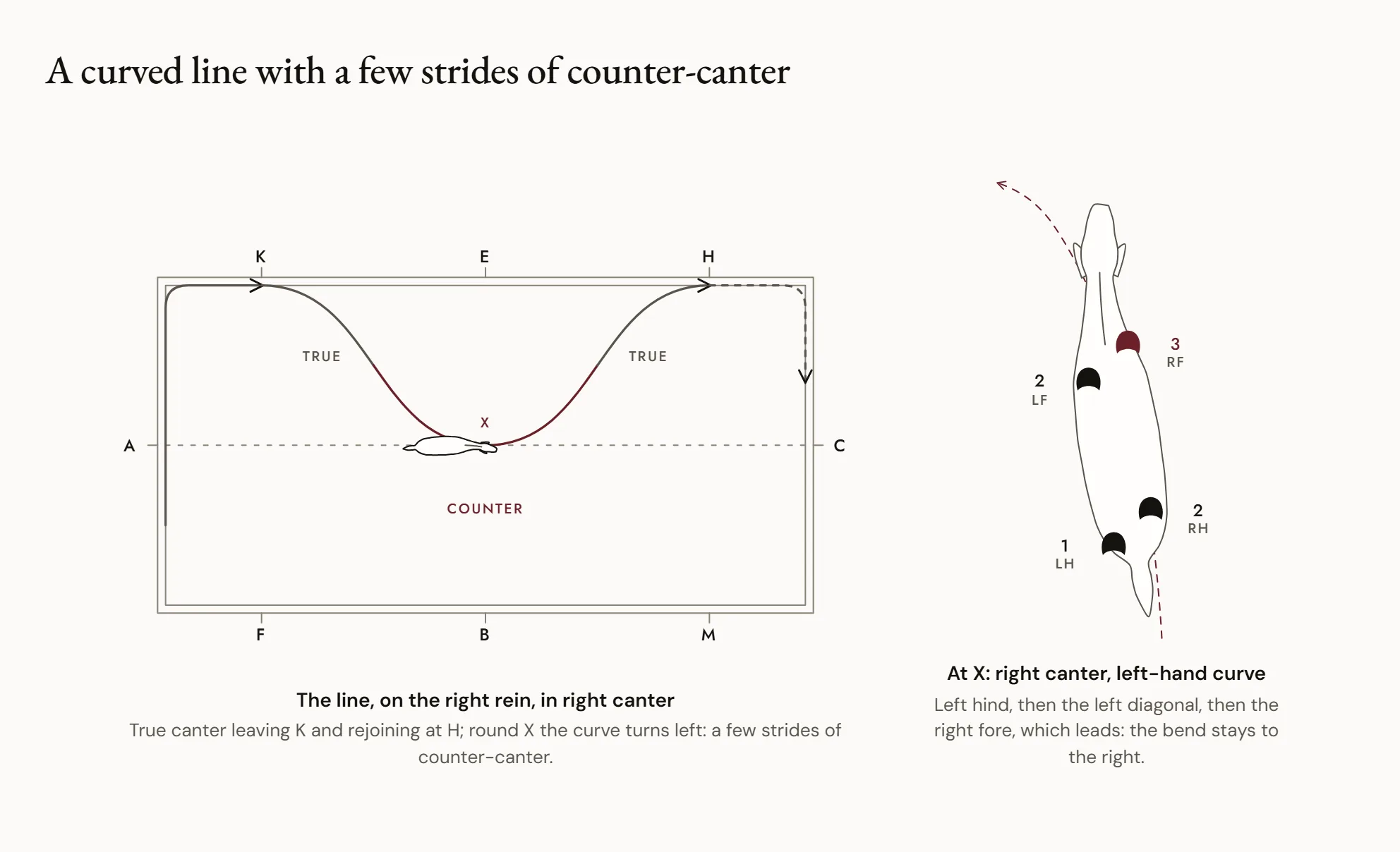
- The canter keeps its three beats, its suspension and the same cadence as in true canter.
- The horse keeps a slight flexion towards its leading leg, even when the curve turns the other way.
- It stays balanced, without going disunited or changing leg, on a wide, rounded curve.
- The rider sits straight, without leaning into the curve.
In counter-canter, the hind leg on the side of the lead is on the outside of the curve and has further to travel: the horse steps under, builds muscle and grows more attentive to the aids. It is also a preparation for flying changes.
At Galop 7: counter-canter from walk and test movements
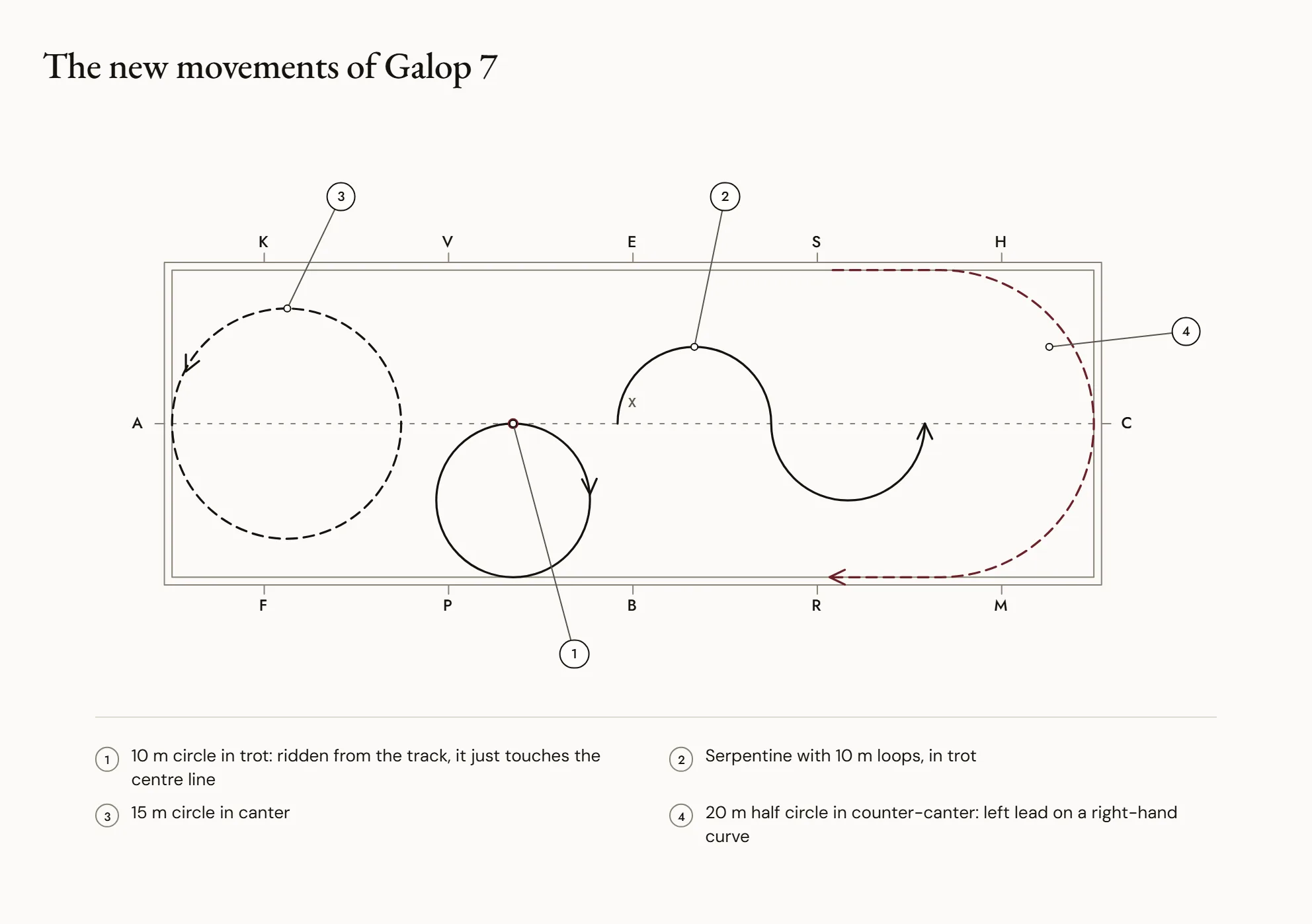
At Galop 7, in the dressage option, counter-canter is asked for from walk, then held on 20 m curves. The test adds canter-walk-canter transitions, 10 to 15 m circles in canter and rein-back followed by moving straight off.
A word from the instructor
Counter-canter is the one moment in a test when you are praised for being on the wrong leg. Enjoy it while it lasts.
Frequently asked questions
- How many beats does a horse’s canter have?
- Three beats, followed by a moment of suspension when no foot touches the ground. In right canter: near hind, then the left diagonal together, then the off fore.
- How do I know if my horse is on the correct lead?
- Lower your eyes, not your shoulders, to the horse’s shoulders: on a right-hand curve, the right shoulder should come further forward. With practice you feel it through your seat.
- What are the aids for right canter?
- The diagonal aids: the right rein turns the head slightly to the right, the left leg drawn back behind the girth asks, the right leg on the girth keeps up the impulsion.
- What is the difference between counter-canter and a disunited canter?
- In counter-canter the horse canters on the lead opposite the curve but stays united and balanced. Disunited, it canters on one lead in front and the other behind: that is a fault.
- At which Galop do you learn how the canter works?
- Striking off on the correct lead at Galop 3, the mechanics of right and left canter at Galop 4, counter-canter at Galop 6, counter-canter from walk at Galop 7.