Horse gaits: walk, trot and canter, and how they work
A gait is a way of moving. The horse has three natural ones — walk, trot and canter — that you learn to recognise by eye, by ear and from the saddle. Here is how each works, foot by foot, what makes a good gait, and what the pace, the broken trot or the piaffe are.
The horse’s three natural gaits
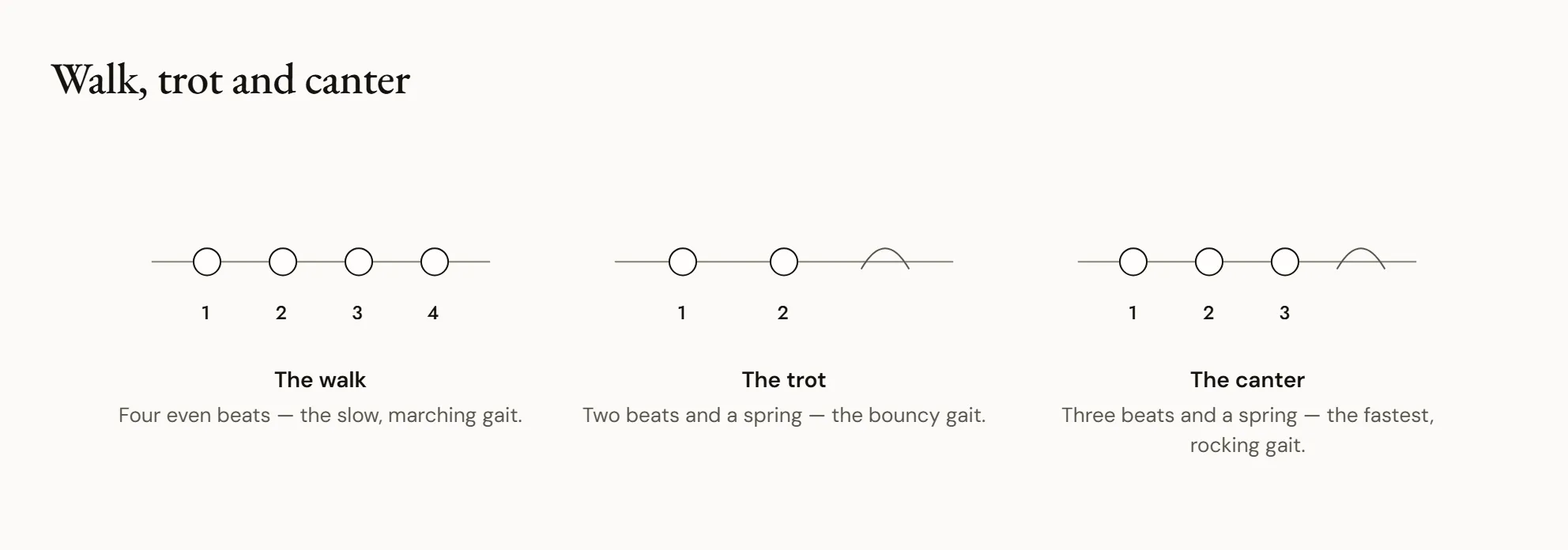
| Clue | Walk | Trot | Canter |
|---|---|---|---|
| Number of beats | 4 | 2 | 3 |
| What you hear | One, two, three, four | One, two | One, two, three… silence |
| A moment in the air? | No: always at least two feet on the ground | Yes, between beats | Yes, after the third beat |
| Speed of a horse | About 6–7 km/h (4 mph) | About 14 km/h (9 mph) | About 20–30 km/h (12–19 mph) |
Tip
Train your ear: stand at the side of the school, close your eyes and count the hoofbeats of a horse going past. Four is walk; two, trot; three and then a silence, canter.
The vocabulary of the gaits
- Footfall
- The moment a foot comes down and takes weight on the ground.
- Beat
- Each footfall you can hear: one foot landing, or several feet landing together.
- Stride
- A complete cycle of a gait, until the feet land again in the same order.
- Suspension
- The instant when no foot is touching the ground.
- Diagonal pair
- A foreleg and the opposite hind leg; it takes the name of its foreleg. The right diagonal is the right fore and the left hind.
The walk: four beats, no suspension
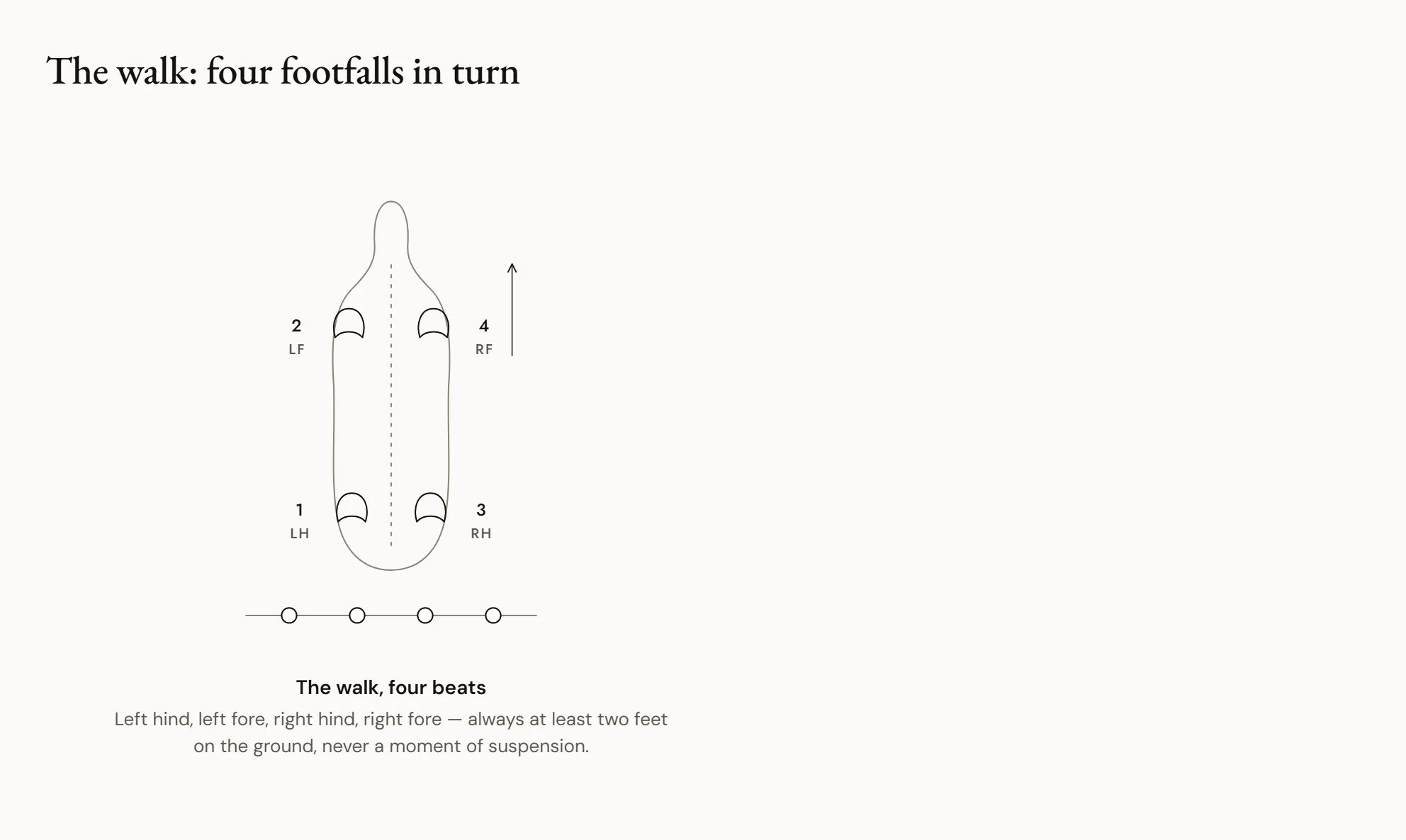
The walk is a stepping gait — always at least two feet on the ground — symmetrical and in four even beats. Each hind leg is followed by the foreleg on the same side: right hind, right fore, left hind, left fore. The horse stands on two feet and on three by turns, and its neck swings with every stride: your hands must follow that swing without blocking it.
The trot: two beats, in diagonal pairs
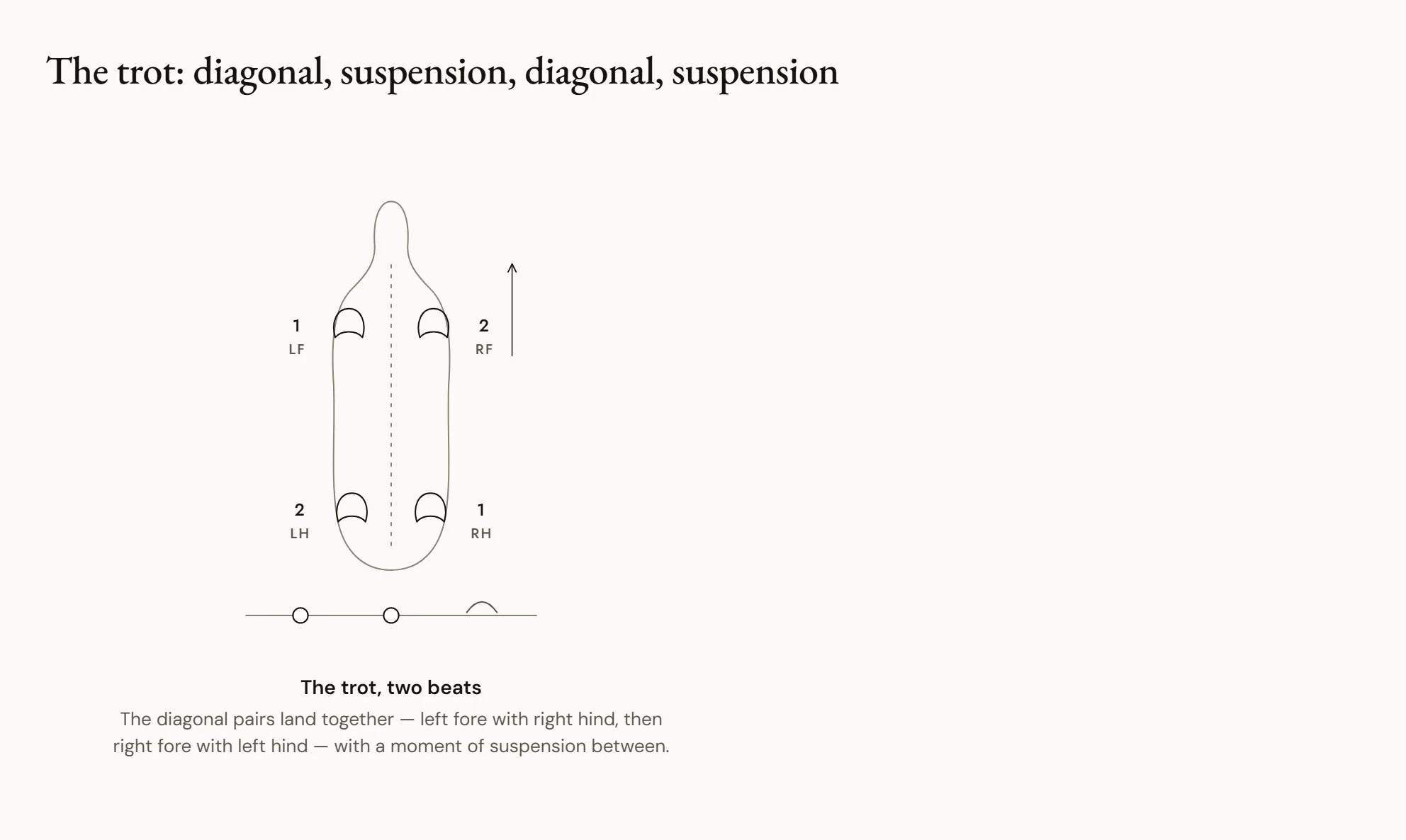
The trot is a springing gait, symmetrical and in two even beats. The feet land in diagonal pairs — the right fore with the left hind, then the left fore with the right hind — separated by a brief moment of suspension. The neck stays almost still: the whole body goes up and down, hence rising trot.
Trotting on the correct diagonal
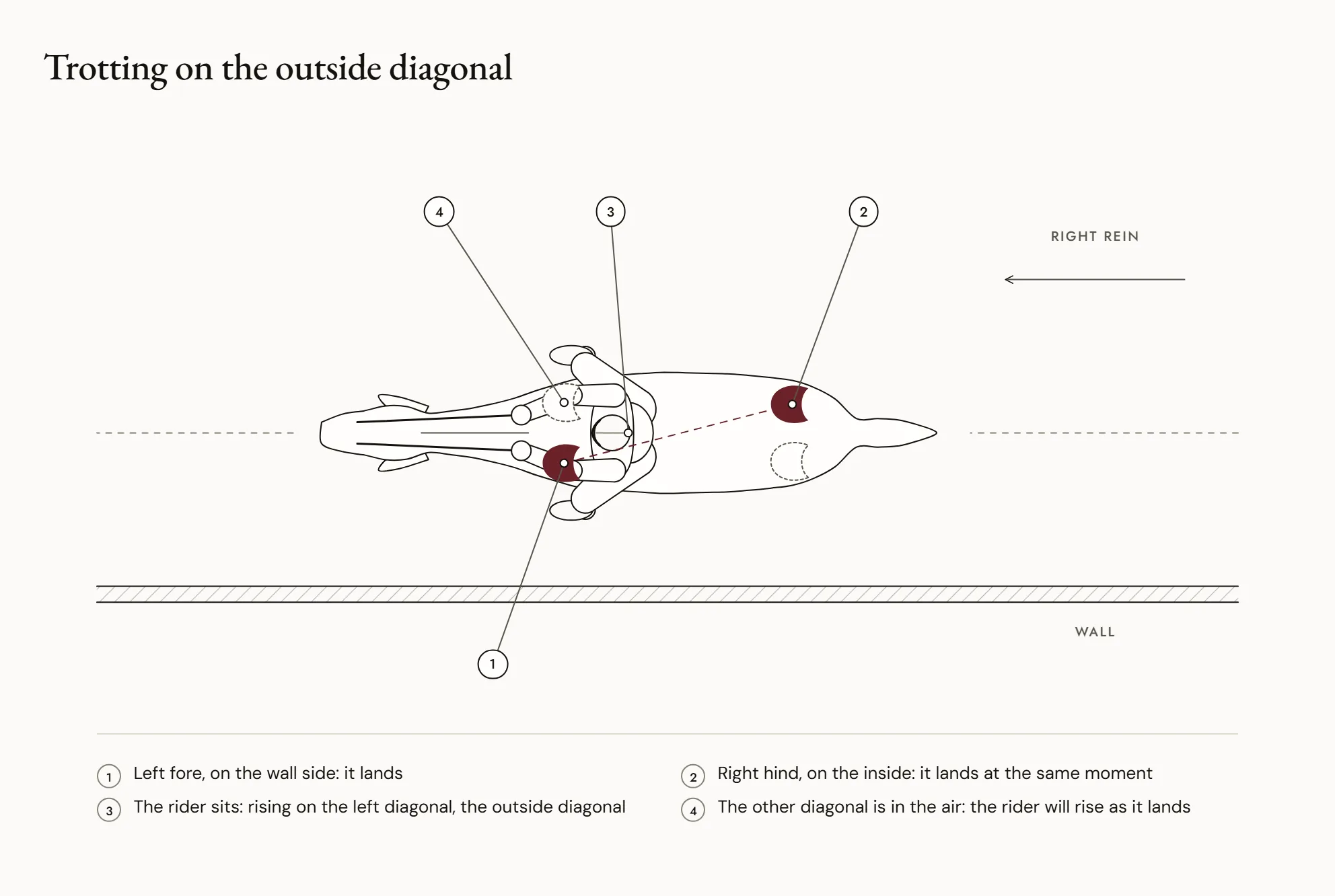
At rising trot, you always sit as the same diagonal pair lands. In the school you trot on the outside diagonal — the left on the right rein, the right on the left rein: you sit as the inside hind, the one that carries most on curves, is on the ground. To change the diagonal, sit for two beats in a row.
Remember
One word, two meanings: a diagonal is a pair of the horse’s legs, and the diagonal is also the line across the school you ride to change the rein. The sentence always tells you which is meant.
The canter: three beats and a moment of suspension
The canter is a springing, asymmetrical gait in three beats followed by a moment of suspension. On the right lead: the left hind, then the left diagonal together, then the right fore, which appears to lead. Its full sequence, the correct lead and counter-canter are covered in our article on the beats of the canter.
Judging a gait: qualities and faults
A gait is judged first on its regularity: even, clearly marked beats. Then come its freedom, its scope, its elasticity and its balance. The back acts as a bridge: supple and toned, it carries the energy of the hind legs through to the front.
A good walk
Long-striding and regular; at medium walk each hind foot lands in front of the print of the forefoot: the horse overtracks.
A good trot
Symmetrical, with real suspension. One diagonal shorter than the other is a possible sign of lameness.
A good canter
Balanced: the hind legs step under, the forehand lifts. A four-beat canter gives stiffness away.
Safety
Irregularity is not a question of style: an irregular horse must be seen by the vet before it is worked.
Faulty gaits and artificial gaits
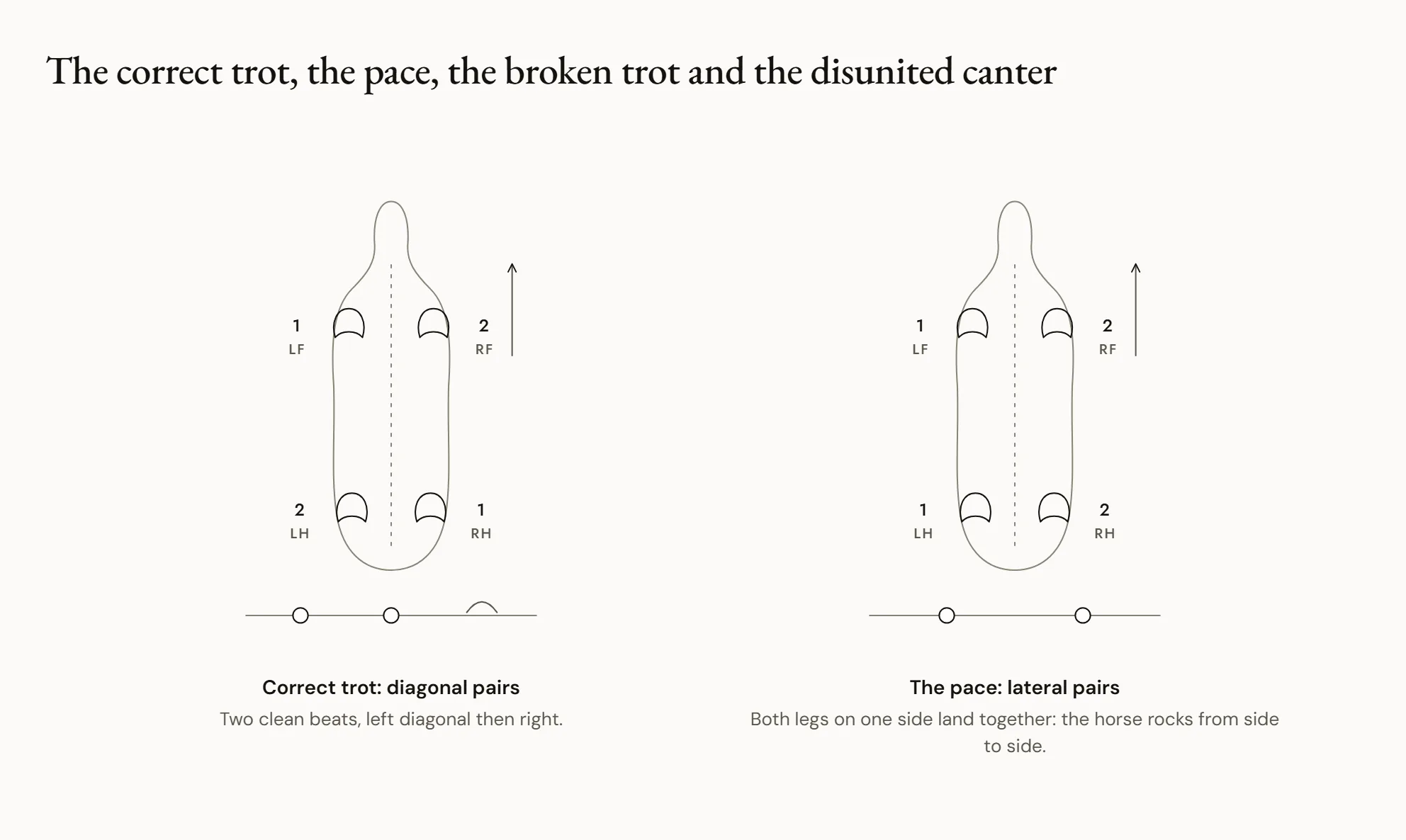
- The pace
- Two beats in lateral pairs: both legs on the same side together. Natural in a few breeds, a fault in a riding horse.
- The broken trot
- A trot that has come apart: the feet of a diagonal no longer land together, and you hear four footfalls.
- The aubin
- The horse canters with one pair of legs and trots with the other.
- The disunited canter
- Right lead in front and left lead behind, or the other way round.
An artificial gait is acquired through training: the passage, a very cadenced trot with a prolonged moment of suspension; the piaffe, a trot almost on the spot; the Spanish walk. Beyond them come the airs above the ground of the haute école — courbette, croupade, capriole — performed by the Cadre Noir of Saumur.
Did you know?
The Icelandic horse’s tölt is a fast, very comfortable four-beat stepping gait. In the breeds born with it, it is called an additional gait, neither artificial nor faulty.
Frequently asked questions
- What are the three gaits of a horse?
- The walk, a stepping gait in 4 beats; the trot, a springing gait in 2 beats; the canter, a springing gait in 3 beats followed by a moment of suspension.
- Why is the trot a two-beat gait?
- Because the feet land in pairs, in diagonal pairs: the right fore with the left hind, then the left fore with the right hind. So you hear two beats per stride.
- What does trotting on the correct diagonal mean?
- Sitting, at rising trot, as the outside diagonal lands: the left on the right rein, the right on the left rein. It helps the horse’s balance on curves.
- What is the pace?
- A two-beat gait in which the horse moves both legs on the same side together. Natural in a few breeds, it is a fault in a riding horse that was not born with it.
- How fast does a horse canter?
- About 20 to 30 km/h (12–19 mph) at a working canter, far more at racing speed. The walk is around 6–7 km/h and the trot around 14 km/h.