Types of bits: recognising each bit and understanding its action
The bit carries the rider’s hand to the horse’s mouth. There are dozens of them, but they all fall into a few families: snaffle bits, which act directly, and bits with shanks — the double bridle, the pelham — which act by leverage. Here is how to recognise them, what each one is for, and why the best bit is still the hand that holds it.
What is a bit?
A bit is made of a mouthpiece, the part that sits in the mouth, and two rings — or two shanks — where the cheekpieces of the bridle and the reins attach. It rests on the tongue and on the bars, the toothless gap between the incisors and the molars, and touches the corners of the lips. The shape of the rings and of the mouthpiece changes how steady it is in the mouth and how it acts.
- Snaffle bit
- It acts without leverage, in line with the rein, on the corners of the mouth and the bars. It is the everyday bit of every rider, from Galop 1 to Galop 7.
- Bit with shanks
- Pelham, curb bit: when the rein tightens, the shank tips and acts by leverage on the bars, the tongue, the chin groove through the curb chain, and the poll.
- Bitless
- The hackamore has no mouthpiece at all: it acts on the nose and the jaw. You meet it mostly on hacks and in western riding.
The usual snaffle bits
Snaffle bits are recognised first by their rings. Five models cover most of what you will find in a riding-school tack room.
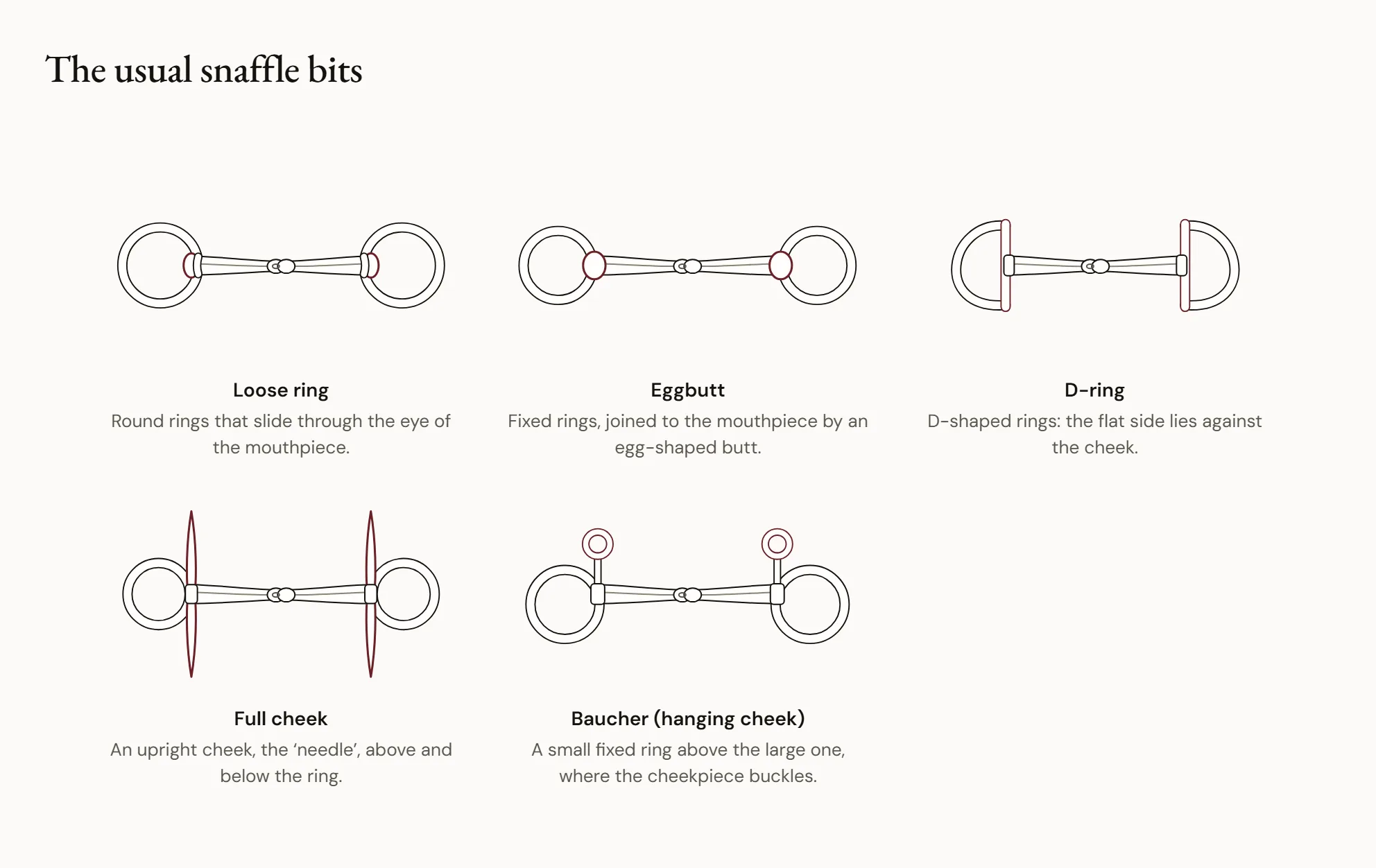
| Bit | How to recognise it | What it does |
|---|---|---|
| Loose-ring snaffle | Round rings that slide freely through the mouthpiece | The simplest: mobile, it lets the horse play with the bit; it can pinch the corners of the mouth |
| Eggbutt snaffle | Fixed rings, joined to the mouthpiece by an egg-shaped piece | Steadier, it does not pinch the lips |
| D-ring snaffle | Rings shaped like a D | Their flat sides press on the cheeks: it helps with turning |
| Full-cheek snaffle | An upright bar — the cheek — above and below each ring | Very directing, it stops the bit sliding through the mouth; widely used on young horses |
| Baucher snaffle | A small fixed ring above each large ring, where the cheekpiece buckles | Very steady, with a slight action on the poll; useful for a horse that leans |
Did you know?
In French yards the name Chantilly sometimes means the loose-ring bit and sometimes the eggbutt, depending on the club and the maker. At the exam, describe the bit rather than relying on its name.
Gag and Pessoa: snaffles with a stronger action
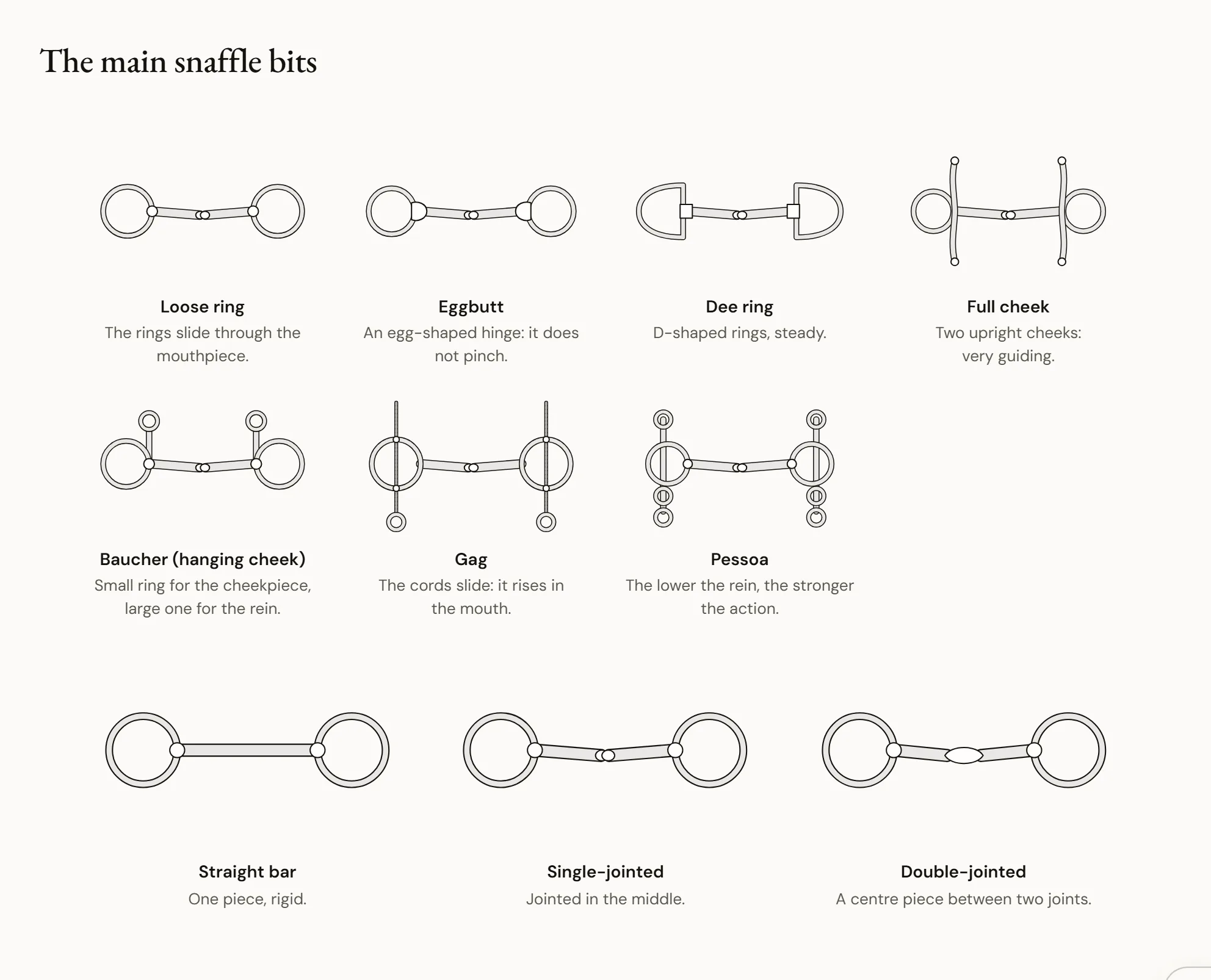
The gag
Rings with holes through which cords slide, the gag cheekpieces. When the rider acts, the bit slides up in the mouth: a lifting effect for a horse that leans on the hand.
The Pessoa
Several rings on each side; the rein fastens to one of them. The lower it is fastened, the stronger the action.
Safety
The gag and the Pessoa act strongly: they are for riders with a secure hand, on the instructor’s advice, and often used with two pairs of reins. In dressage tests only certain bits are allowed: the discipline’s rules give the list.
The mouthpiece: straight, single- or double-jointed
Two bits with the same rings can act very differently depending on their mouthpiece. It is the mouthpiece that spreads the pressure over the tongue and the bars.
- Straight bar: a single piece, in metal or a soft material such as rubber. It presses mostly on the tongue.
- Single-jointed: jointed in the middle, the most common. It follows the shape of the mouth but, pulled hard, closes into a V on the tongue and the bars.
- Double-jointed: a small centre piece between two joints. It pinches the tongue less and suits many sensitive horses.
- Material and thickness: stainless steel, rubber, resin, copper… A thicker mouthpiece spreads the pressure and is usually milder, provided the mouth has room for it.
The double bridle: two bits with opposite effects
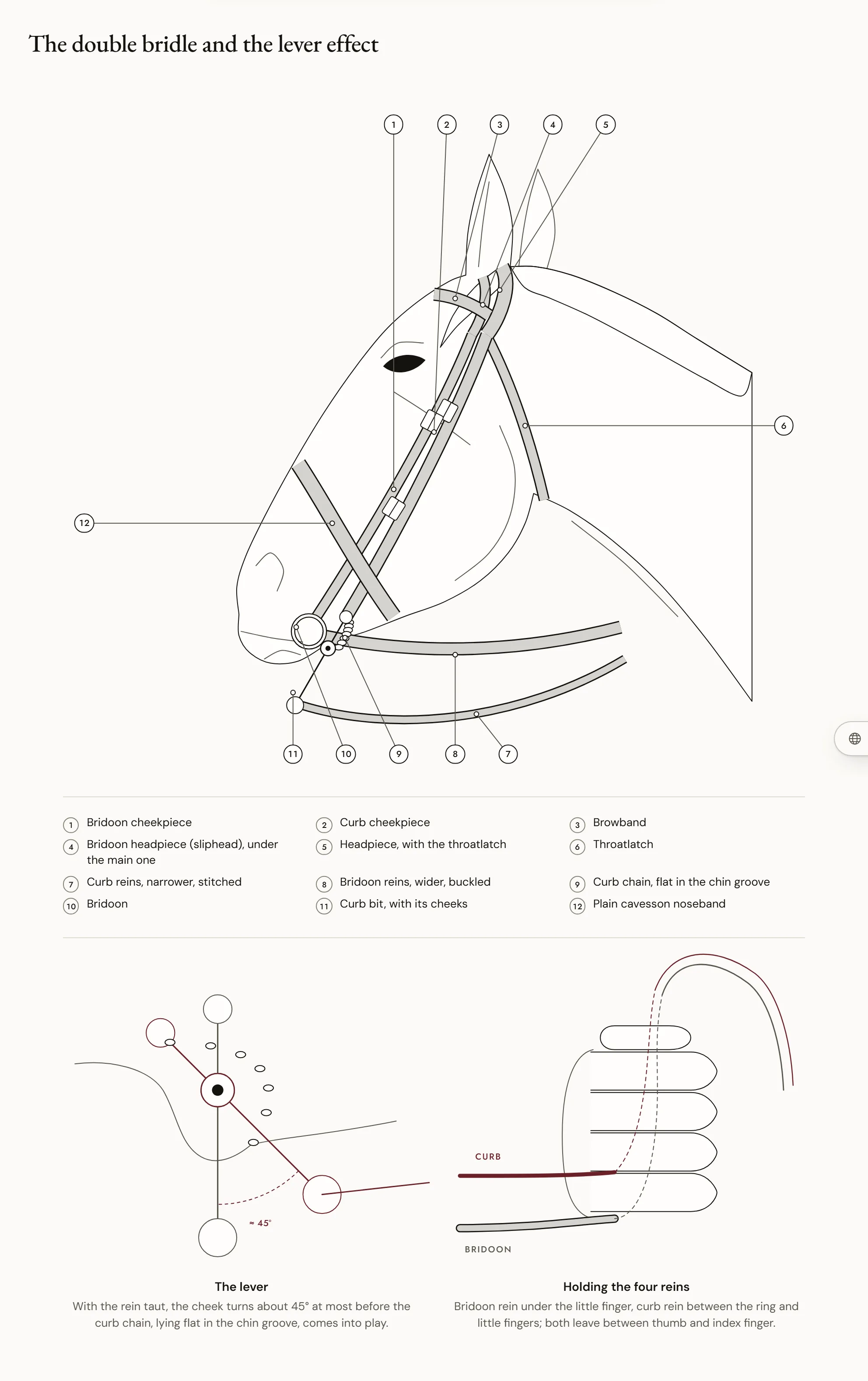
A double bridle carries two mouthpieces, each with its own pair of reins: a thin snaffle, also called the bridoon, and a curb bit, a bit with shanks and a curb chain that lies in the chin groove. It is an instrument of precision, not a stronger brake: it is kept for a rider with an independent hand and a horse already on the bit in a snaffle.
Lifting effect
The bridoon
It acts on the corners of the lips, in line with the rein. It is the bit of the constant contact and of steering. Its reins, the wider pair, are joined by a buckle.
Flexing effect
The curb bit
It acts by leverage: the shank tips, the mouthpiece presses the bars and the tongue, the curb chain presses the chin groove and the cheekpieces act on the poll. Its reins, the thinner pair, are stitched.
The strength of the lever depends on the length of the shanks and the adjustment of the curb chain: with the curb rein taut, the shank should not tip more than about 45° before the chain comes into play. The pelham combines both actions on a single mouthpiece with shanks, often with two pairs of reins.
Choosing and fitting a bit
- Width: the bit shows about half a centimetre on each side of the mouth, without pinching or sliding.
- Height: it makes a slight wrinkle at the corners of the mouth — one wrinkle, two at most. Too low, it knocks the teeth; too high, it pulls the lips.
- Thickness: thicker is milder, if the horse’s mouth has room for it.
- The rules: in competition each discipline publishes its list of permitted bits; check it before you enter.
Common mistake
Believing a “stronger” bit will fix a horse that pulls. The mildest bit turns harsh in a stiff hand: it is the hand you correct first, with your instructor.
A word from the instructor
You do not put a double bridle on for more brakes, but for more nuance. The horse that lacks brakes mostly needs more work in a snaffle.
Frequently asked questions
- What is the mildest bit for a horse?
- A snaffle with a thick mouthpiece, often double-jointed or in a soft material, fitted at the right width and height. But no bit is mild in a harsh hand: mildness comes from the rider first.
- What is the difference between a snaffle and a double bridle?
- A snaffle bridle carries one bit that acts without leverage, in line with the rein. A double bridle carries two bits: a thin bridoon, which lifts, and a curb bit with shanks and a curb chain, which flexes by leverage.
- What is a full-cheek snaffle for?
- Its two upright cheeks press on the sides of the face and stop the bit sliding through the mouth: it helps the horse turn. It is widely used on young horses.
- How do I know if a bit is the right size?
- It should show about half a centimetre on each side of the mouth and make a slight wrinkle at the corners. If it pinches the lips it is too narrow; if it slides from side to side it is too wide.
- At which Galop do you learn about bits?
- The usual snaffle bits are on the Galop 4 syllabus, the main snaffle bits — gag and Pessoa included — on Galop 5, and the double bridle on Galop 7.