Horse muscles: the engines of movement
The bones are the levers; the muscles are the engines. Knowing what each main group does means understanding what your exercises work — why a horse builds muscle slowly, and why its tendons are watched so closely.
How does a muscle work?
A muscle is made of fibres that can contract — that is, shorten — and then relax. By pulling on the bones through the tendons, it moves a joint. There are three kinds of muscle.
- Skeletal muscles
- Also called striated muscles, attached to the bones and under the horse’s control: they do the moving.
- Smooth muscles
- In the walls of the organs and blood vessels, they work without the horse having to think about it: digestion, circulation.
- Cardiac muscle
- The myocardium, which contracts without rest and without any act of will.
The five muscle groups and what they do
| Group | What it does | An example |
|---|---|---|
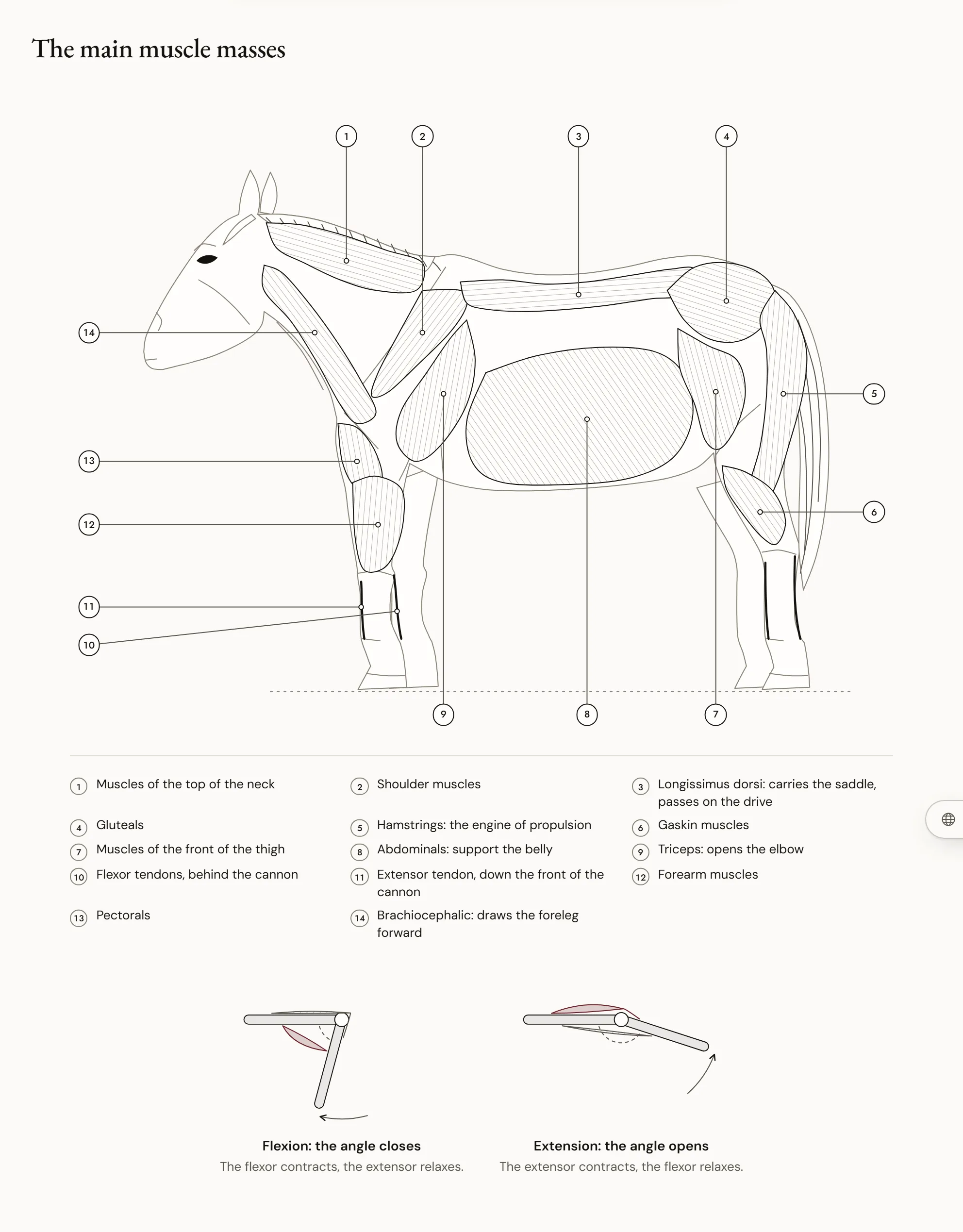
| Extensors | Open the angle of a joint: the leg straightens, the neck lifts — so they are also called levators | The triceps opens the elbow as the foreleg reaches forward |
| Flexors | Close the angle of a joint: the leg bends, the neck lowers — so they are also the depressors | They fold the knee and the fetlock as the foot leaves the ground |
| Abductors | Move a leg away from the body’s midline | The muscles that swing the foreleg out to the side |
| Adductors | Bring a leg back towards the body’s midline | The inside of the thigh; they make the legs cross in a leg-yield |
| Rotators | Turn a segment on its own axis | The deep muscles of the hip |
- Synergist muscles
- They act in the same direction and add their forces together for the same movement.
- Antagonist muscles
- They have opposite actions on the same joint, like the extensors and the flexors: when one contracts, the other must relax.
The big muscle masses you feel under the saddle
- The neck muscles, including the brachiocephalic, which runs from the head to the upper arm and draws the foreleg forward.
- The longissimus dorsi, either side of the spine from the withers to the croup: it passes the thrust of the hind legs forward and carries the saddle.
- The abdominals, which support the belly and help the back to round.
- The gluteals and the hamstrings, in the croup and the back of the thigh: the engine of propulsion.
Remember
Below the knee and the hock there is no muscle at all: only bone, tendon and ligament. That is why tendons are watched so closely, and why they are protected at work and at rest.
Building up a horse: regular, progressive work
A muscle grows stronger through regular, progressive work, after a warm-up at the walk. Flatwork exercises — bend, leg-yield, lengthened strides, transitions — call on synergist and antagonist muscles in turn: proper gymnastics, built over weeks, not sessions.
Tip
A back that is building well shows it: the longissimus dorsi rounds on each side of the spine and the topline fills out, from the withers to the croup.
A word from the instructor
A horse does not put on muscle in one lesson, any more than you do in one gym session. Regular beats hard, for him as for you.
Frequently asked questions
- What are a horse’s main muscles?
- The neck muscles, including the brachiocephalic; the longissimus dorsi, along the back; the abdominals; and the gluteals and hamstrings of the quarters, the engine of propulsion.
- Are there muscles in a horse’s lower legs?
- Above the knee and hock, yes. Below them, none: only bone, tendon and ligament, worked from a distance by the muscles higher up the leg.
- What is the difference between an extensor and a flexor muscle?
- An extensor opens the angle of a joint — the leg straightens; a flexor closes it — the leg bends. They are antagonist muscles.
- How do you build up a horse’s back?
- With regular, progressive, well-warmed-up work that asks him to round and bring his hind legs under: bend, transitions, leg-yield, work with a lowered, stretched neck.