The saddle and the bridle: the parts, the fitting and the care
Tack is what joins the rider to the horse: the saddle on the back, the bridle on the head. Knowing every piece, and how to put it on, fit it and look after it, protects the horse’s back and mouth — and your own safety. Here is the full vocabulary, from the pommel to the noseband.
The parts of the saddle
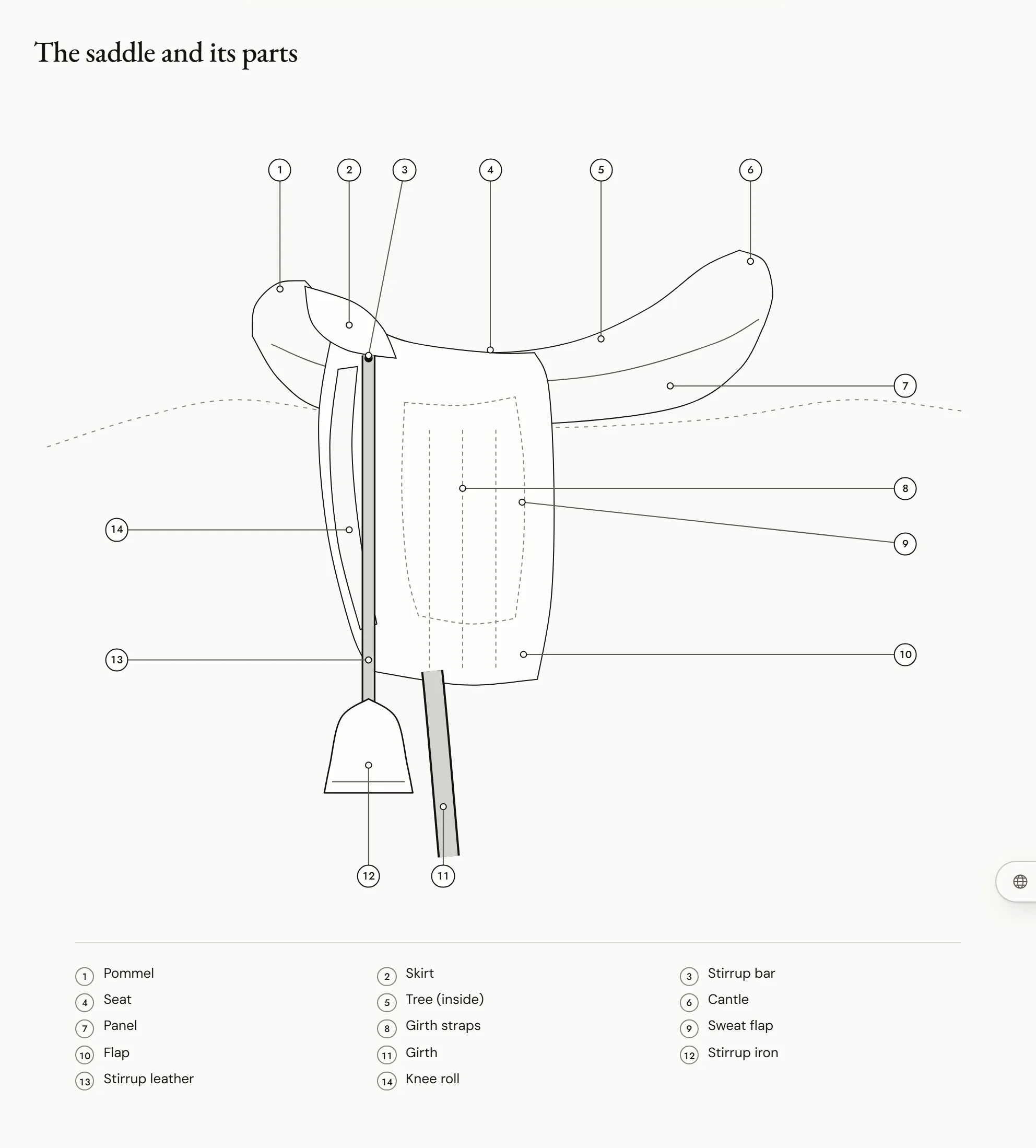
- The pommel
- The raised front of the saddle, which arches over the withers without touching them.
- The seat and the cantle
- The seat is the part you sit on; the cantle is its raised back edge.
- The flap and the knee rolls
- The flap is the large leather panel under your leg; the knee rolls are the padded blocks that support your knee and thigh.
- The skirt
- The small flap that covers the stirrup bar, the metal hook the stirrup leather hangs from.
- The stirrup leather and iron
- The stirrup leather is the adjustable strap that carries the stirrup iron, where you put your foot.
- The sweat flap and the girth straps
- Under the flap, the sweat flap covers the girth straps, the straps fixed to the tree that the girth buckles onto.
- The panels and the tree
- The panels are the cushions that rest on the back; between them, a channel leaves the spine free. The tree is the hidden frame that gives the saddle its shape.
The parts of the bridle
The bridle — a snaffle bridle at this level — is the headgear you ride in. The headcollar has no bit: it is for holding and tying up. Never tie a horse up by its bridle.
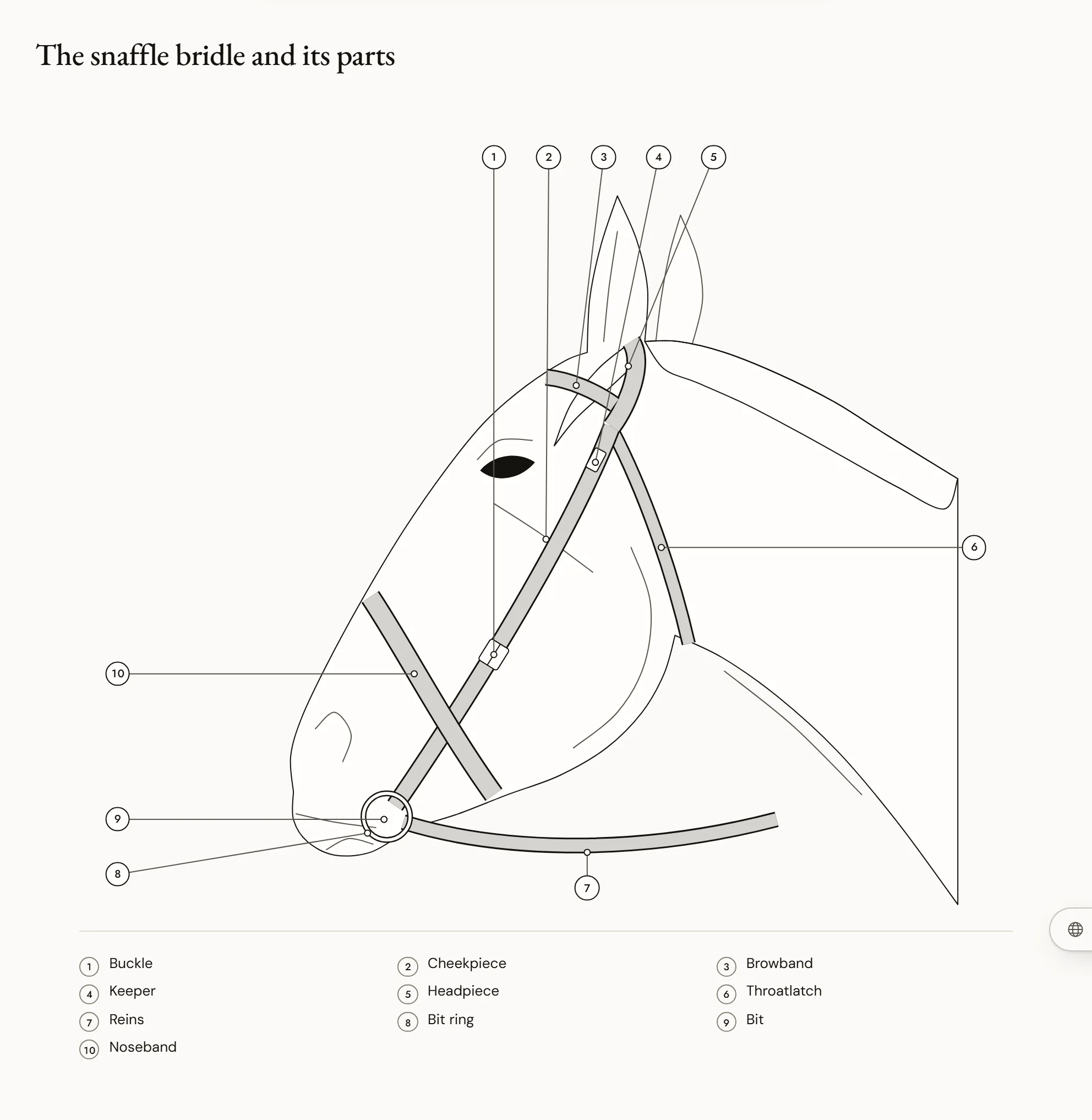
- The headpiece
- Goes over the poll, behind the ears, and carries on into the throatlatch.
- The throatlatch
- Goes under the throat and is buckled loosely, with room for a fist. It stops the bridle coming off over the ears.
- The browband
- Goes across the forehead below the ears and stops the headpiece slipping back.
- The cheekpieces
- Down each side of the face, they join the headpiece to the bit. Their length sets the height of the bit.
- The noseband
- Goes round the nose, held up by its own headpiece. It stops the horse opening its mouth too wide.
- The bit and the reins
- The bit rests on the bars; the reins, buckled to its rings, connect the mouth to your hands.
Putting on the bridle, step by step
- Get readyBuckle the headcollar round the neck: the horse stays tied up. Lay the reins over the neck.
- Take your placeOn the left of the head, facing forwards. Your right arm goes under the jaw, your right hand holds the headpiece in front of the forehead; your left hand offers the bit, flat, under the mouth.
- Open the mouthSlide your left thumb into the corner of the lips, onto the bars. When the horse opens, lift your right hand: the bit goes in without knocking the teeth.
- Ease the ears throughBring the headpiece behind one ear, then the other, folding them gently forwards. Pull the forelock out over the browband.
- Buckle up and checkThe throatlatch with room for a fist, the noseband with room for two fingers. The bit touches the corners of the lips without pulling them.
Common mistake
Banging the bit against the teeth or dragging the ears through the headpiece. The horse will remember next time — and put its head up out of reach.
Saddling up, step by step
- Put the numnah onA little in front of the withers, then slide it back, with the lie of the hair.
- Put the saddle onGently, the pommel over the withers; slide it back a little, with the numnah, until it leaves the shoulder free.
- Free the withersLift the numnah up into the arch under the pommel: your fingers should slide flat between the numnah and the withers.
- Do up the girthLet the girth down on the off side without it banging the legs, then buckle it on the near side, not too tight: you will tighten it in stages, before you mount and then in the saddle.
Common mistake
Putting the saddle too far forward, on the shoulder, or doing the girth up tight all in one go: the horse tenses up, and some will object.
Fitting the tack to this particular horse
Fitting means checking that every piece is in its place and at the right length on this particular horse: no two horses have the same head or the same back.
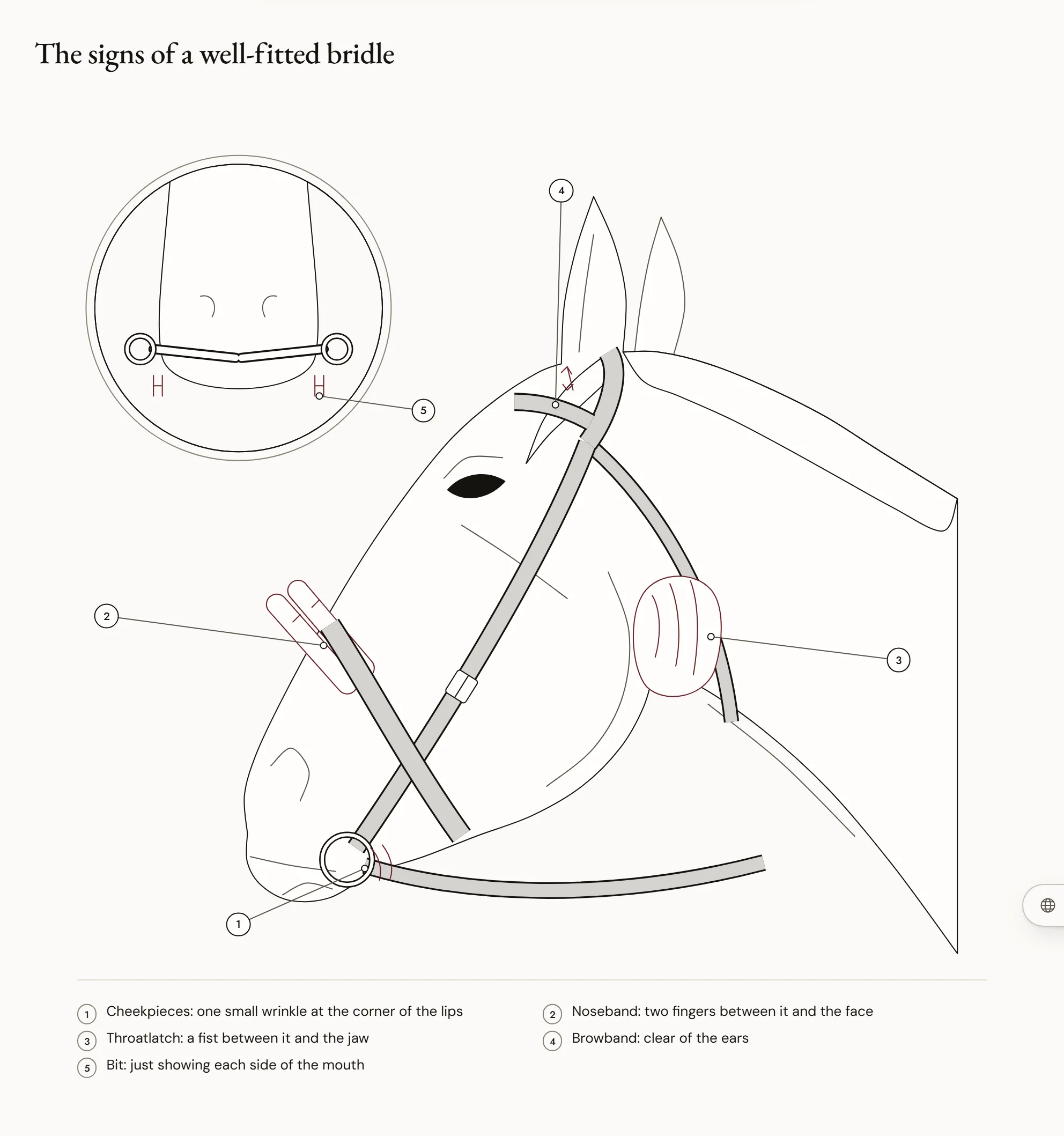
| Part | Correct fit | If it is wrong |
|---|---|---|
| Cheekpieces | The bit makes a small wrinkle at the corners of the lips, without pulling them. | Too short, they pull on the lips; too long, the bit hangs and the horse plays with it. |
| Width of the bit | It shows a few millimetres beyond each side. | Too narrow, it pinches; too wide, it slides from side to side. |
| Noseband | Two fingers below the facial crest; two fingers between it and the face. | Too high, it rubs the bone; too tight, it stops the horse chewing. |
| Throatlatch | You can fit your fist between it and the jowl. | Too tight, it bothers the poll and the breathing. |
| Browband | It does not touch the base of the ears. | Too short, it pulls the headpiece against the ears. |
- The saddle sits behind the shoulder, with the withers well clear and the numnah pulled up into the gullet.
- The girth lies straight in the girth groove; to smooth out wrinkles of skin, stretch each foreleg forward.
- The stirrups are the same length on both sides; for jumping they are shortened by one or two holes.
Caring for the saddle and the bridle
- After every ride: wash the bit in clean water, run up the stirrups, put the saddle on its rack and hang the bridle up by the headpiece. Hang the numnah up to dry.
- Regularly: clean all the leather with glycerine saddle soap and a well wrung-out sponge — leather is never soaked — then feed it with a thin layer of balm.
- Every time you clean it: check stitching, stirrup leathers, girth straps and girth. A worn piece is replaced before it breaks.
- To take a bridle apart: first note which hole each buckle is on, then reassemble it exactly — noseband inside the cheekpieces, bit the right way round.
A word from the instructor
A saddle left on the floor will sooner or later meet a boot, a hoof or a wheelbarrow. Its rack is the only place where it is safe.
Frequently asked questions
- What are the parts of a saddle?
- The pommel, the seat, the cantle, the flaps and knee rolls, the skirt, the stirrup leather and iron, the girth straps and girth, the panels, and the tree hidden inside.
- What is the difference between a headcollar and a bridle?
- The headcollar has no bit: it is for holding and tying up the horse. The bridle has a bit and reins: it is for riding. You never tie a horse up by its bridle.
- How do I know if a bridle fits properly?
- A small wrinkle at the corners of the lips, two fingers under the noseband, a fist under the throatlatch, a browband that does not touch the ears, and a bit that shows just a little beyond each side of the mouth.
- Where should the saddle sit on a horse’s back?
- Behind the shoulder, the pommel over the withers without touching them, the numnah pulled up into the gullet to keep the withers clear.
- How do you look after saddle leather?
- With glycerine saddle soap and a well wrung-out sponge, never soaking the leather, then a thin layer of balm once dry. Too much product clogs the leather.