Parts of the horse: from the poll to the hoof, the full vocabulary
“Pat his neck”, “the girth goes just behind the elbows”: to follow an instruction, care for a horse or report an injury, you need the name of each of its parts — and to be able to point to them. Here is the outside of the horse, from the three main regions to the details of the leg, in the words of the yard.
The three main regions: forehand, body, hindquarters
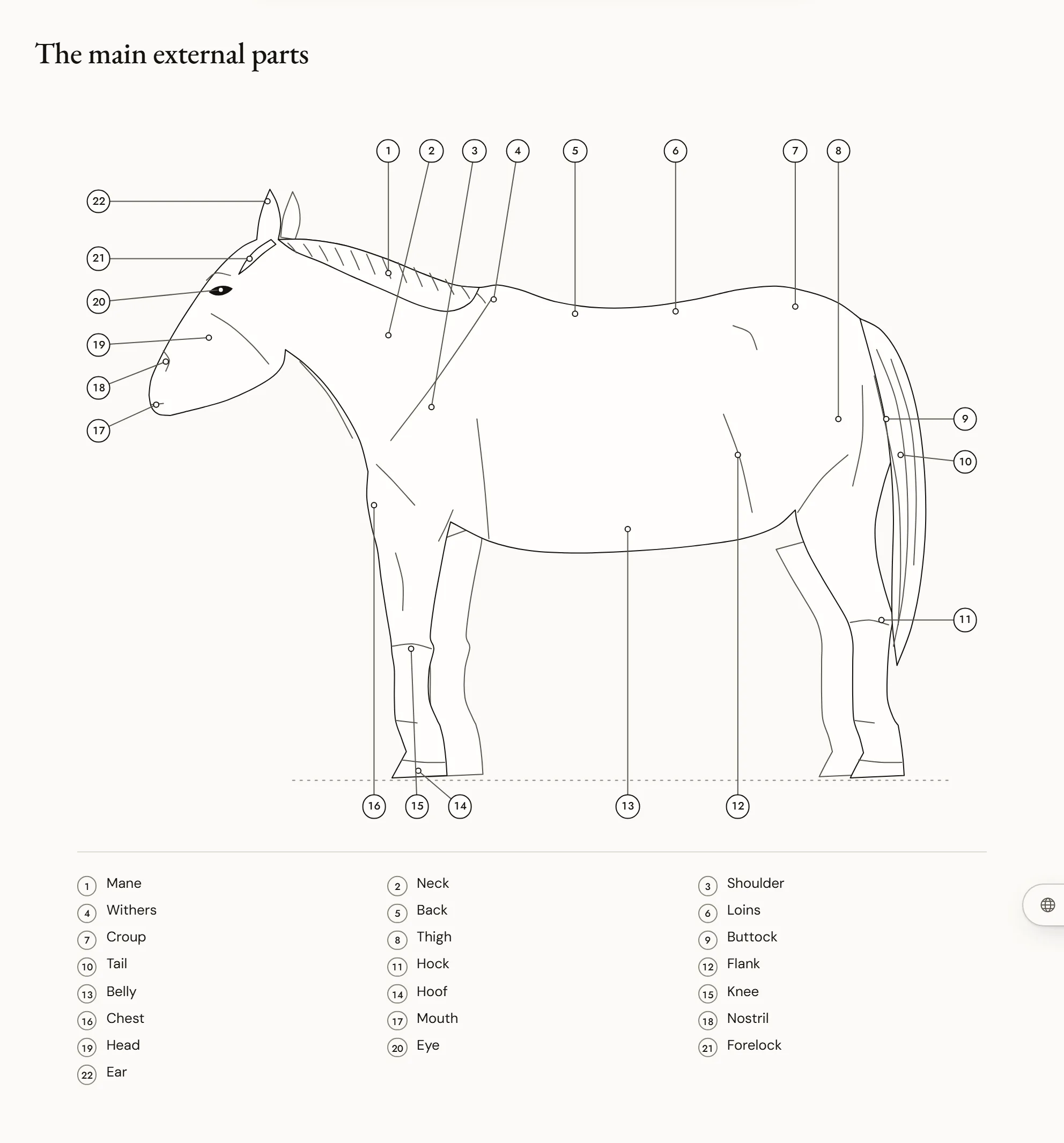
The horse is described in three main parts. Once you are in the saddle, they are easy to remember: the forehand is in front of you, the body underneath you, the hindquarters behind you.
| Region | What you find there |
|---|---|
| The forehand | The head and its nostrils, the neck topped by the mane, the shoulder, the chest, the forelegs. |
| The body | The withers, the highest point of the back; the back, where the saddle sits; the loins; the ribs; the belly; the flank, which hollows and fills as the horse breathes. |
| The hindquarters | The hips, the croup, the tail, the hind legs. |
Did you know?
A horse’s height is measured at the withers, with a measuring stick. In competition, the FFE counts as a pony any equid that stands no more than 1.48 m at the withers unshod, or 1.49 m shod — about 14.2 hands.
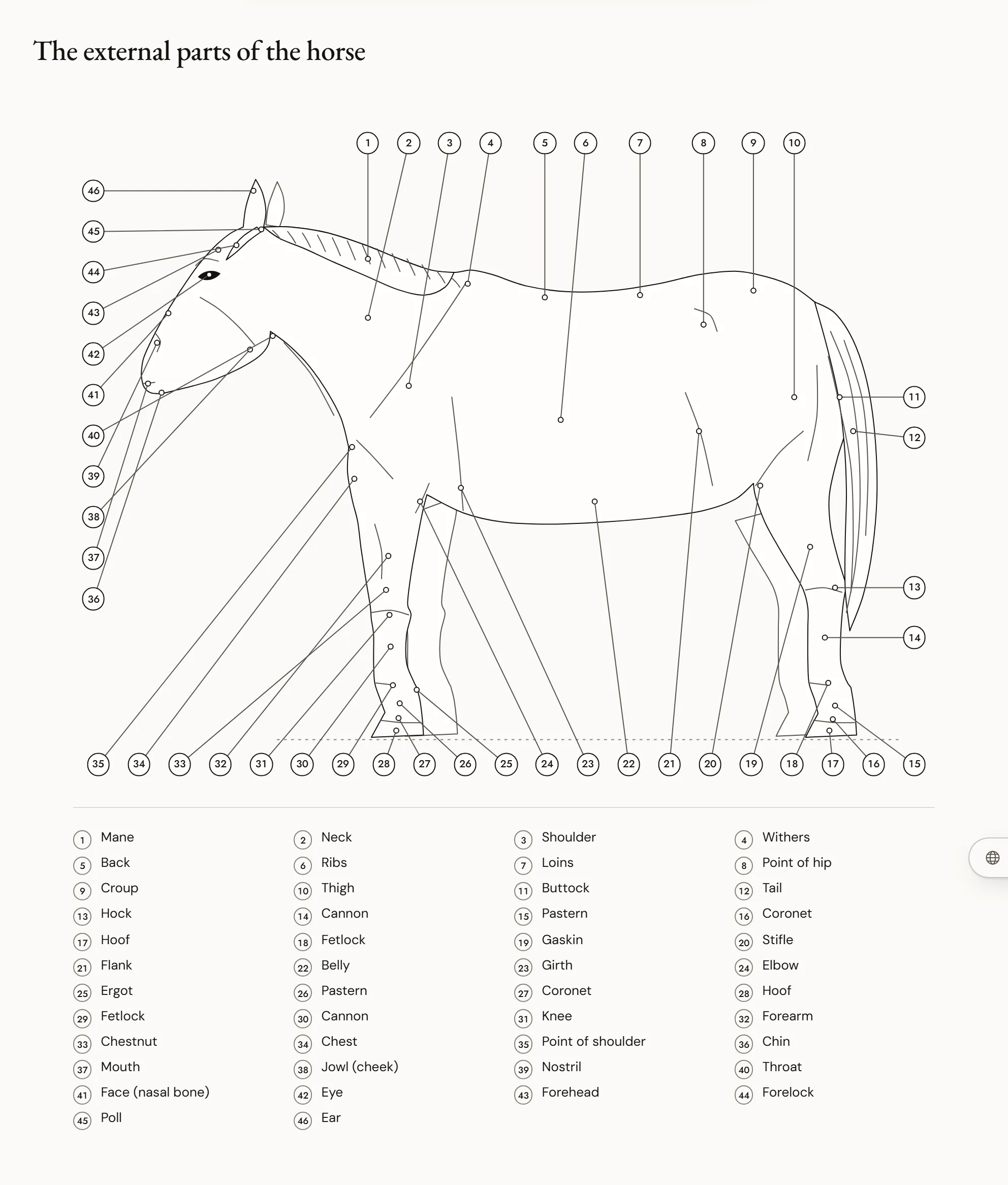
All the external parts of the horse
| Part | Where to find it |
|---|---|
| Poll | Just behind the ears, where the headpiece lies. |
| Forelock | The lock of hair that falls between the ears onto the forehead. |
| Forehead and eye hollows | The forehead lies between and above the eyes; the hollows are the dips above each eye. |
| Face | The front of the head, from the forehead down to the nostrils. |
| Corner of the mouth | Where the lips meet, and where the bit rests. |
| Chin and chin groove | The chin is under the lower lip; the chin groove is the hollow just behind it, where the curb chain lies. |
| Jowl and channel | The jowl is the back edge of the lower jaw; the channel, the hollow between its two branches. |
| Parotid and throat | The parotid lies under the ear; the throat is where the head meets the neck, underneath. |
| Part | Where to find it |
|---|---|
| Jugular groove | The furrow along the lower part of the neck, where the jugular vein runs. |
| Withers, back, loins | The withers are the ridge at the top of the shoulders; the back carries the saddle; the loins carry on to the croup. |
| Armpits | The folds between the tops of the forelegs and the chest, with the space that separates the forelegs between them. |
| Girth groove, flank | The girth goes round just behind the elbows; the flank is the hollow between the ribs and the hip. |
| Point of hip and croup | The point of hip juts out at the top of the flank; the croup runs from the loins to the tail. |
| Buttock, thigh, stifle | The buttock is below the tail, the thigh in front of it; the stifle is the prominent joint at the front of the thigh. |
Common mistake
The right words
Riders say forehand and hindquarters, never “front end” and “back end”. And don’t confuse the hip, the bony point on the side, with the croup, the rounded top that slopes down to the tail.
The horse’s legs: knee, hock, cannon, fetlock, pastern
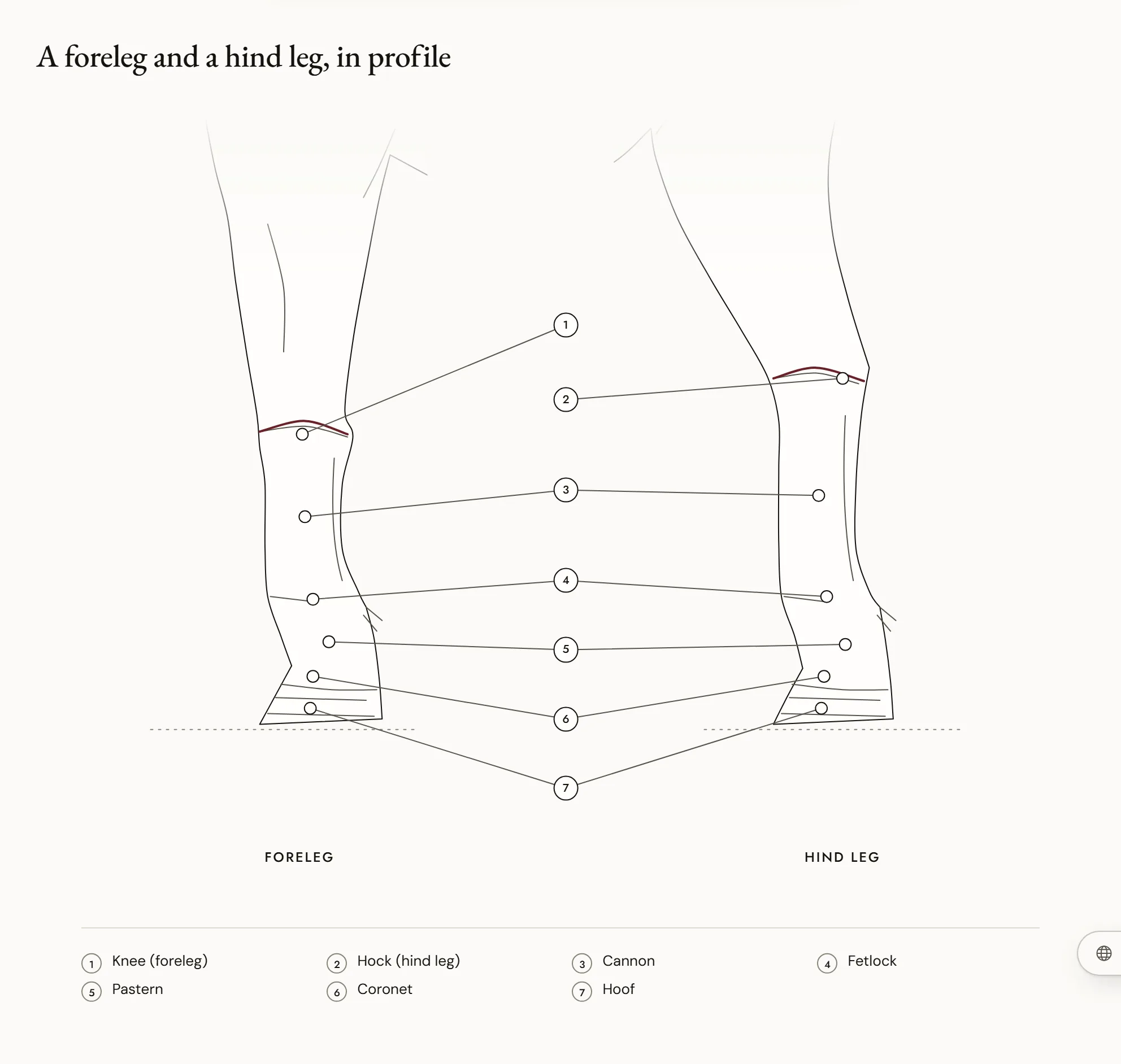
The horse has two forelegs and two hind legs. From the middle of the leg down to the ground, the parts have the same names in front and behind, except for the big joint in the middle: the knee at the front and the hock at the back.
- The knee
- On the foreleg, the flat joint halfway down the leg.
- The hock
- On the hind leg, the angled joint whose point faces backwards.
- The cannon
- The long, straight part below the knee or hock; at the back, you can feel the tendons under your fingers.
- The fetlock
- The rounded joint at the bottom of the cannon, with the feather behind it, the tuft of hair that hides the ergot.
- The pastern
- The short, sloping part between the fetlock and the coronet.
- The coronet and the hoof
- The coronet is the band the horn grows from; the hoof, the horny box that encloses the foot.
In full, the foreleg reads from top to bottom: shoulder, point of shoulder, arm, elbow, forearm, chestnut, knee, cannon, tendons, fetlock, feather, pastern, coronet, hoof. The hind leg: gaskin, hock with its point, chestnut, then once again cannon, fetlock, feather, pastern, coronet and hoof.
Tip
To remember the order
From top to bottom, starting at the knee or hock: Kind Children Feed Ponies Carrots Happily — knee or hock, cannon, fetlock, pastern, coronet, hoof.
Did you know?
The chestnut, a horny patch on the inside of the legs, and the ergot, hidden in the feather, are thought to be what remains of the toes the horse’s ancestors had millions of years ago.
Pointing to the parts of the horse safely
- To revise, on the left side and working from front to back, lay your hand on each part and name it under your breath.
- A foreleg: stand beside the shoulder, facing the horse’s tail, and run your hand down the leg.
- A hind leg: stay close to the body, level with the hip, one hand resting on the quarters; run the other down the thigh to the hock.
- Always stay on your feet, bending if you need to, never kneeling or squatting, and never behind the horse.
Safety
Heat, swelling, a wound or lameness is reported to your instructor at once, before you ride.
A word from the instructor
The horse’s knee matches your wrist, and its hock your ankle. In other words, your pony walks about on its fingertips all day — and never complains.
Frequently asked questions
- Where are a horse’s withers?
- The ridge at the top of the shoulders, at the base of the neck: the highest point of the back. That is where a horse’s height is measured.
- What is the difference between a horse’s knee and hock?
- The knee is the middle joint of the foreleg, the hock that of the hind leg. The horse’s knee matches our wrist, the hock our ankle.
- What is the chestnut on a horse’s leg?
- A horny patch on the inside of the legs, above the knee and below the hock. With the ergot, it is thought to be what remains of toes lost over evolution.
- What are the parts of a horse’s leg, top to bottom?
- From the knee or hock down: cannon, fetlock, pastern, coronet and hoof — with the tendons at the back of the cannon and the feather behind the fetlock.
- At which Galop do you learn the parts of the horse?
- The main parts at Galop 1, the parts of the legs at Galop 2, and all the external parts, from the poll to the feather, at Galop 3.