Grooming a horse: the brushes, the order and the right moves
Grooming cleans the horse, massages it and gets it ready for work. It is also the moment to examine it from head to foot and check that it is well before you saddle up. Here is the full kit, the order of grooming, and the moves that protect the horse — and you.
The grooming tools
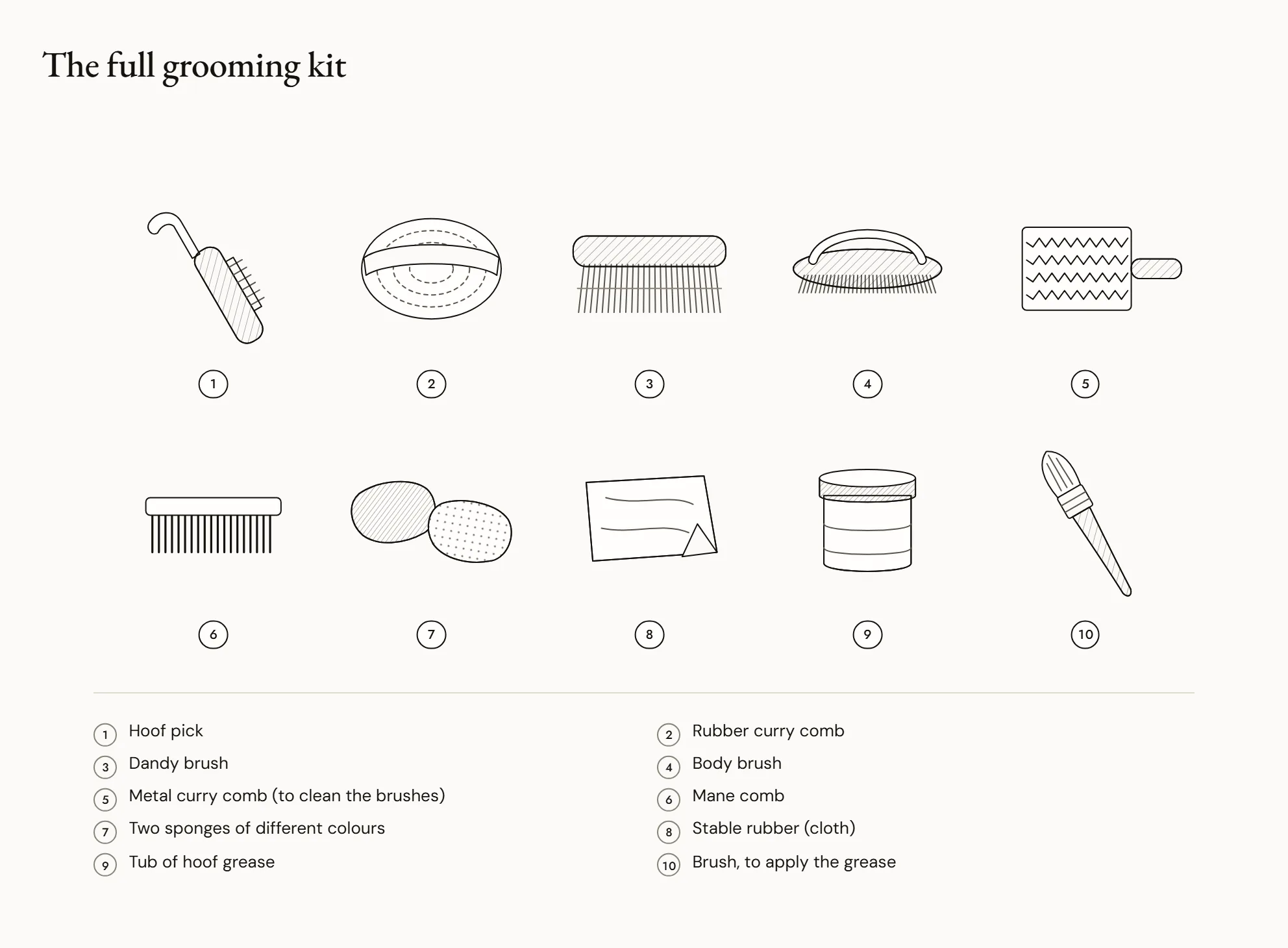
| Tool | What it is for |
|---|---|
| Hoof pick | Clearing earth, dung and stones from the underside of the foot. |
| Rubber curry comb | Loosening mud and dead hair, in small circles, on the fleshy parts. Never on the head or on bone. |
| Dandy brush | A stiff brush that flicks away the loosened dust, in the direction of the hair. |
| Body brush | Smoothing the coat and cleaning the sensitive areas: the head, the lower legs. |
| Metal curry comb | Cleaning the brushes between strokes — never used on the horse. |
| Mane comb or brush | Untangling the mane and the tail. |
| Two sponges | One for the eyes and the nostrils, the other for under the tail. |
Common mistake
Using the curry comb on the legs or the head, where the bone lies just under the skin: it hurts, and a horse in pain defends itself. The curry comb is for muscle, the brush for everything else.
Curry comb and brush: where, and which way
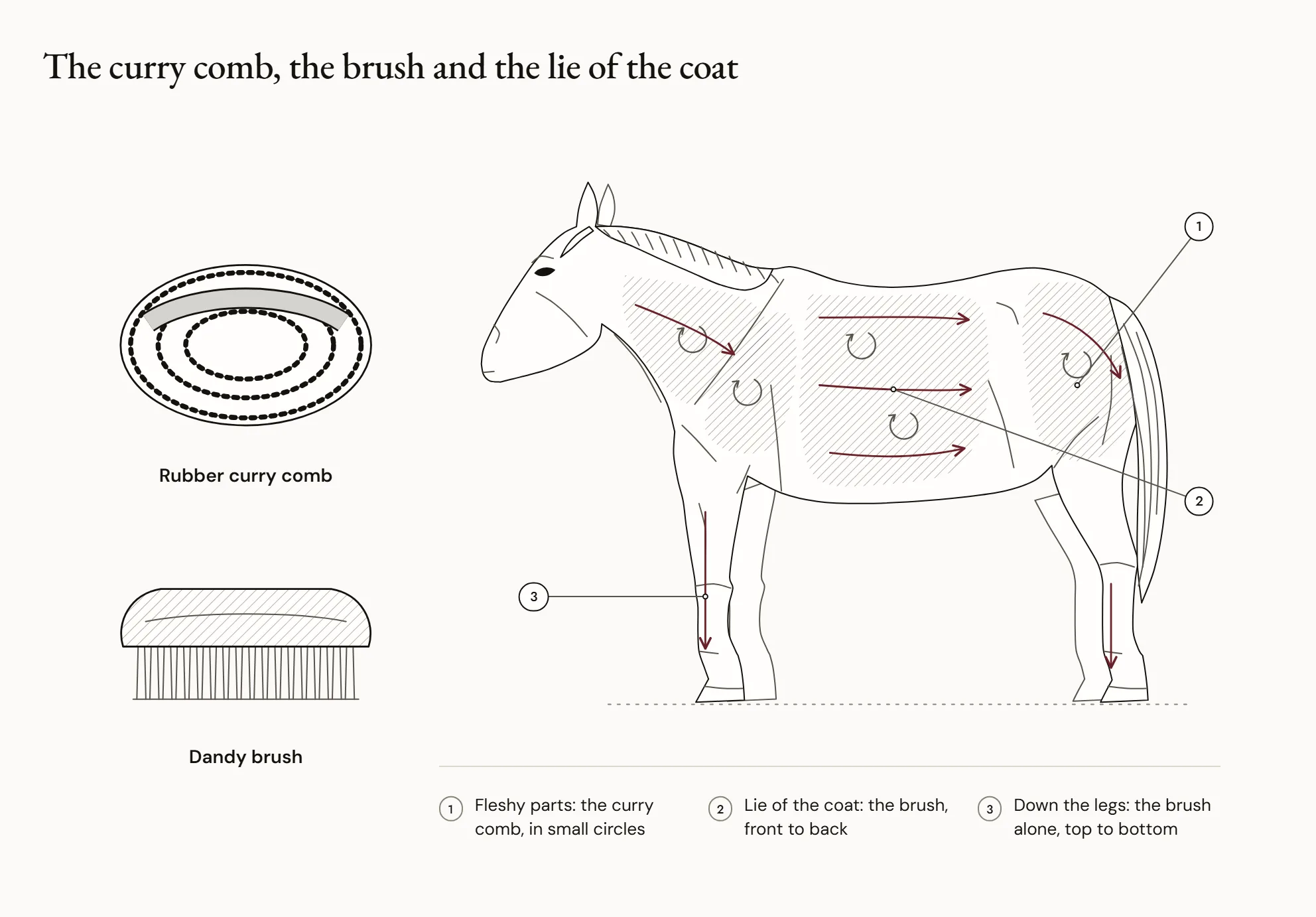
The curry comb is worked in circular movements on the fleshy parts — neck, shoulders, back, flanks, quarters, thighs — where there is muscle under the skin. The brushes go the way the hair lies: from front to back on the body, from top to bottom on the legs.
A word from the instructor
The horse knows exactly where the curry comb feels good. If it stretches its neck and wiggles its lip, you have found the spot; if it pins its ears, you have found the other one.
A full grooming, in order
- Tie upTo a ring, with a quick-release knot and a short lead rope.
- Pick out all four feetStart with the feet: a stone comes out sooner, and the shoes are checked before work.
- CurryNear side first, then off side, from the neck to the croup, in small circles, without pressing on the bones.
- Dandy brushIn the direction of the hair, with brisk strokes that flick the dust away from the horse, legs included.
- Finish with the body brushThe whole body, then the head, gently, one hand resting on the front of the face. Clean it on the metal curry comb every two or three strokes.
- Untangle the mane and tailThe mane lock by lock; the tail preferably by hand, so as not to break the hairs.
- Sponge, oil, polishThe eyes and nostrils with the first sponge, under the tail with the second; oil the feet, then go over the coat with the stable rubber to make it shine.
- CheckNo wounds, no hot or swollen areas; the back and the girth area perfectly clean, otherwise the saddle will rub.
Remember
Before riding
Where the saddle and girth will go — the back, the withers and the girth area — the coat must be spotless: one crust of mud under the saddle is enough to make a back sore.
Picking out the feet safely
- A front footStand beside the shoulder, facing the tail. Run your hand down the leg to just above the fetlock and say “up”, squeezing the back of the cannon lightly.
- A hind footStand close against the horse level with the hip, facing the tail, one hand resting on the croup. Run the other hand down the thigh to the hock, then down the cannon, and ask for the foot.
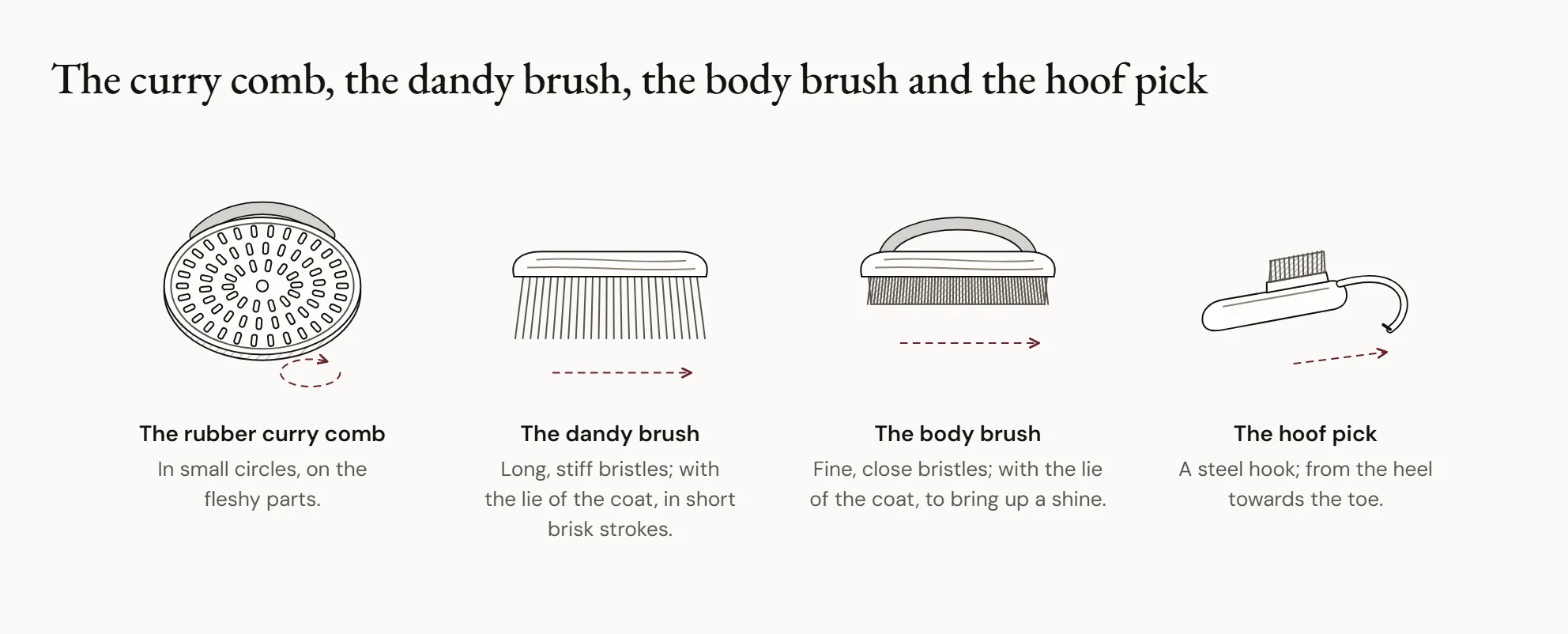
- Pick outFrom heel to toe, working the hoof pick away from you. Clear the clefts on each side of the frog well, without digging into the frog itself. Finish with the brush.
- Put it downLower the foot all the way to the ground instead of dropping it.
Safety
With a hind leg, stay right up close to the horse, at its side, never behind it and never squatting. Your shoulder against its thigh lets you feel what it is doing; if it fidgets, let go of the foot and step away.
Hosing the legs and oiling the feet
After work, above all in hot weather, hosing cleans the legs and cools the tendons. Set a gentle jet of cool water, start on the hoof of a foreleg and work gradually up to the knee or the hock; hose each leg for several minutes, then dry the backs of the pasterns: damp there causes cracked heels.
Hoof oil keeps the horn supple. Brush it onto a foot that is picked out, clean and dry — on a wet foot it would seal the damp in — starting at the coronet, where the horn grows, then over the whole wall.
A word from the instructor
Two sponges of different colours: one for the eyes, one for the other end. The day you mix them up, your horse will remember it for a great deal longer than you will.
Frequently asked questions
- In what order do you groom a horse?
- Pick out the feet, curry, dandy brush, finish with the body brush, untangle the mane and tail, sponge the eyes, nostrils and under the tail, oil the feet and polish the coat.
- What is the difference between a dandy brush and a body brush?
- The dandy brush has long, stiff bristles: it flicks away the dust loosened by the curry comb. The body brush has fine, close-set bristles: it smooths the coat, brings up a shine, and is the only brush used on the head.
- Where do you use a curry comb on a horse?
- Only on the fleshy parts — neck, shoulders, back, flanks, quarters, thighs — in small circles. Never on the head, the lower legs or bony points.
- How do you pick out a horse’s hoof?
- From heel to toe, working the hoof pick away from you, clearing the clefts on each side of the frog without digging into the frog. Then lower the foot to the ground without dropping it.
- Should you oil a horse’s hooves?
- Yes, on a foot that is picked out, clean and dry, starting at the coronet: oil keeps the horn supple. On a wet foot it would seal the damp in.