The horse’s hoof and shoeing: from the bare foot to the farrier’s work
“No foot, no horse,” as the old saying goes. The horse’s whole weight rests on four hooves that absorb every stride. Knowing the parts of the hoof, what lies under the horn and what good shoeing looks like means being able to say exactly what is wrong — and knowing when to call the farrier.
The foot and the hoof: what are they for?
The foot is the end of the leg; the hoof is its horny casing, hard but slightly flexible, which protects the living parts inside — as our nails protect our fingertips. The foot has three jobs: it carries the horse’s weight, it absorbs the shocks and it helps with propulsion.
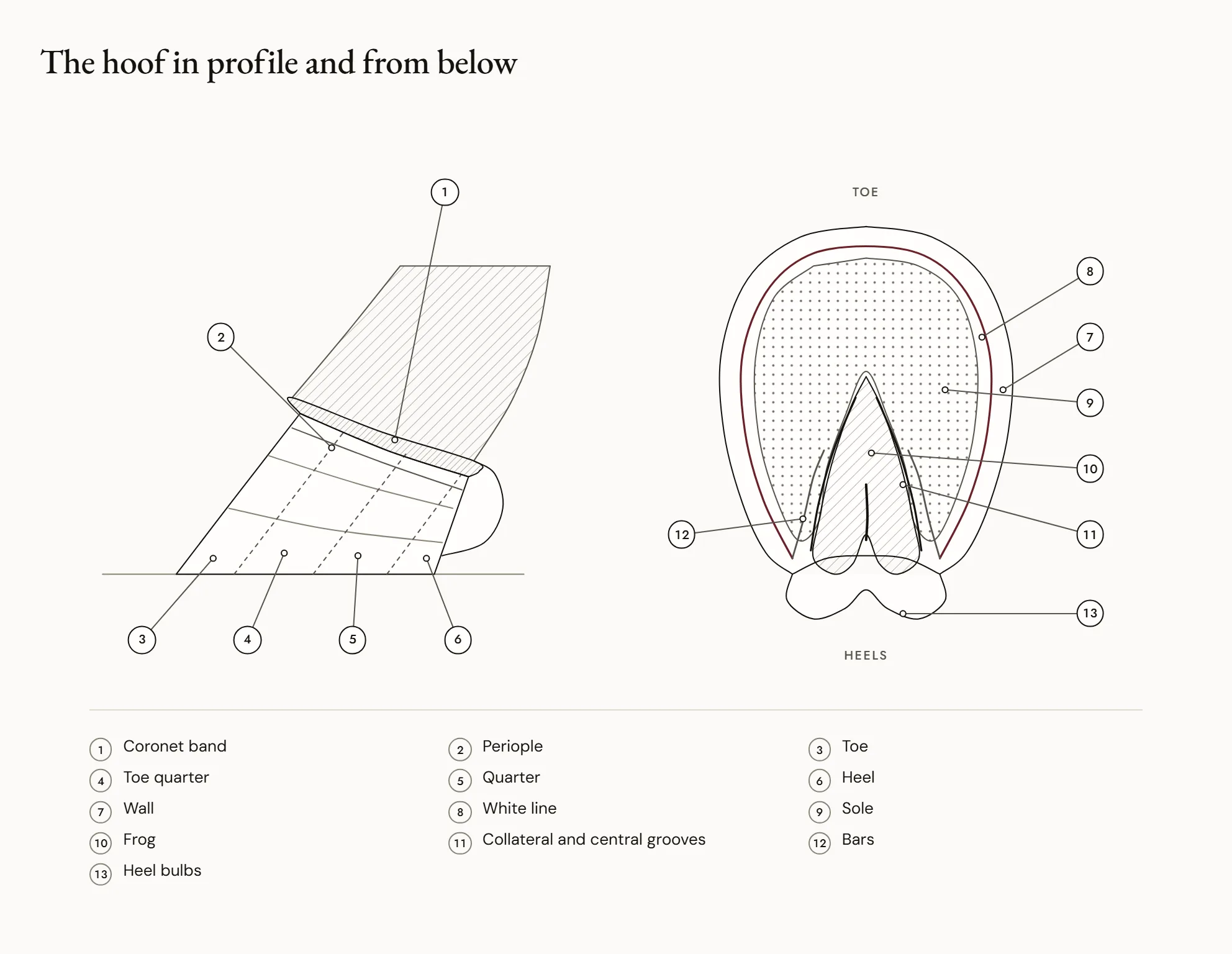
The parts of the hoof
- Coronet
- The band just above the hoof, where the hair stops. This is where the horn of the wall is made, and it grows downwards from there.
- Periople
- A thin band of soft, shiny horn just below the coronet; it stops the wall drying out.
- Wall
- All of the hoof you can see when the foot is on the ground, divided from front to back into the toe, the toe quarters, the quarters and the heels.
- Sole
- A slightly concave plate of horn that protects the underside of the foot.
- Frog
- Softer, V-shaped horn, point to the front; it touches the ground at every stride and helps absorb the shock.
- Clefts and bars
- The clefts are the grooves on each side of and down the middle of the frog, where earth and stones lodge; the bars are the folds of the wall that run alongside the frog.
- White line
- The join between the wall and the sole: the farrier’s guide for placing the nails.
- Bulbs of the heel
- The soft swellings that finish off the heels, at the back of the foot.
Remember
The wall, from front to back: toe, toe quarters, quarters, heels. Underneath: sole, frog, clefts, bars, white line. At the back: the bulbs of the heel. At the top: the coronet and the periople.
Inside the foot: bones, living tissue and shock absorbers
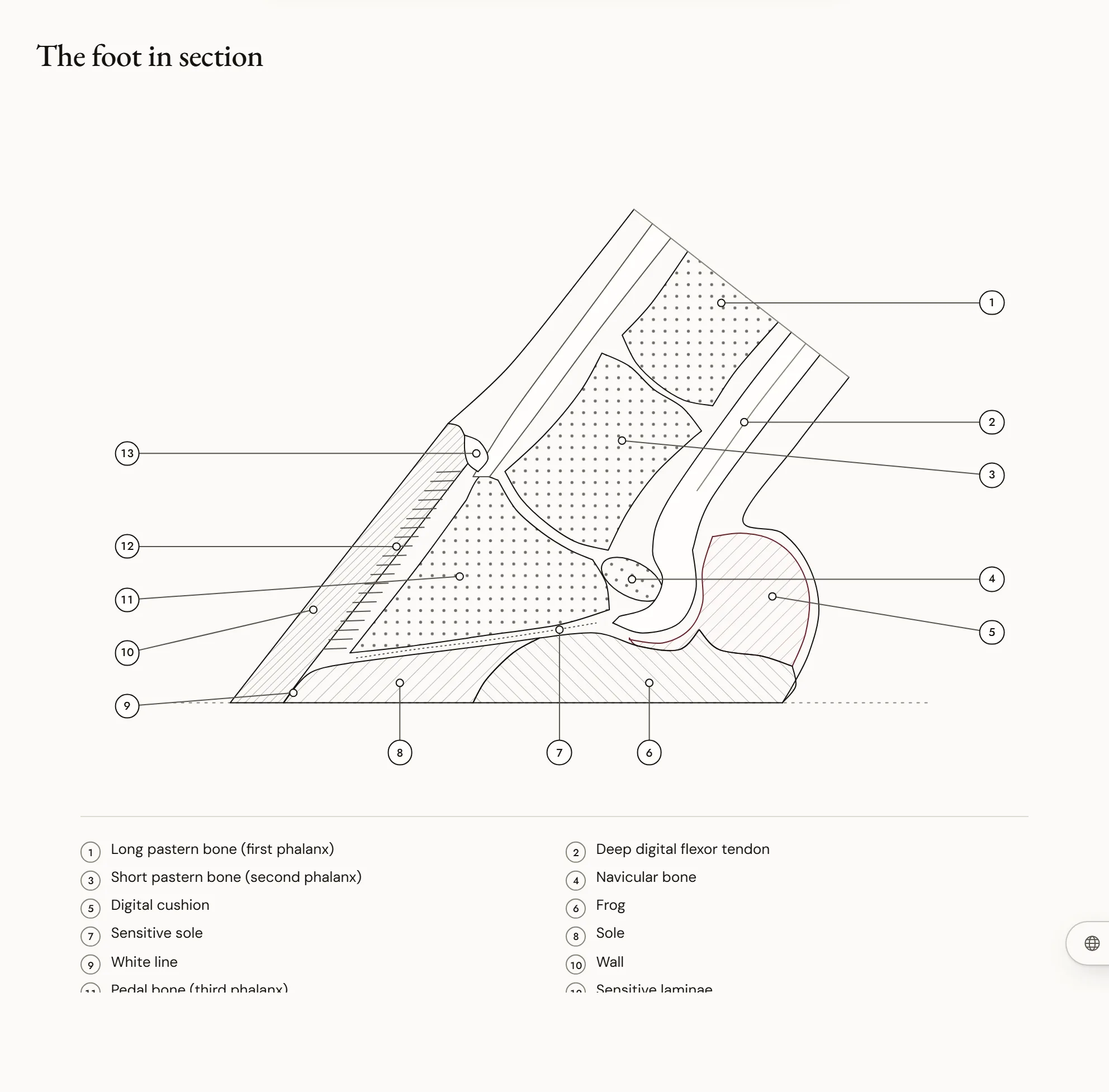
- The bones
- The lower end of the short pastern bone, the pedal bone — shaped like a small hoof — and the navicular bone, tucked in behind, over which the deep digital flexor tendon glides.
- The living tissue
- The sensitive laminae lock the wall to the pedal bone; the sensitive sole produces the sole and the frog; the coronary band produces the wall.
- The shock absorbers
- The digital cushion, an elastic pad above the frog, and the two lateral cartilages, which extend the pedal bone back towards the heels.
At every stride, the horse’s weight pushes the pedal bone down inside the hoof. The digital cushion, squeezed between the bone and the frog, flattens and pushes the cartilages apart: the heels open slightly, the shock is absorbed and blood is pumped out and drawn back in. A foot whose frog no longer takes weight — heels too high, a rotten frog — cushions badly and sends the jar up into the joints.
Why the feet need care: trimming and shoeing
Horn grows all the time, about a centimetre a month: it takes nearly a year for the wall to renew itself completely. In the wild, wear makes up for growth; in work and in the stable it no longer does. Hence the daily care — picking out before and after work, washing, oiling — and regular visits from a professional.
Trimming
The farrier, or a trimmer, removes the excess horn and rebalances the foot. Every foot needs trimming regularly, shod or not.
Shoeing
A shoe, usually of steel, is fixed under the wall with nails. It protects the horn from wearing too fast; it can also correct the way the foot lands.
Barefoot
Many horses do very well barefoot, trimmed regularly, depending on their work and the quality of their horn.
Tip
When you pick out the feet, check the shoes: a shoe that moves or clanks, a missing nail, a clench that has risen, horn growing over the shoe. Report it before you ride: a shoe that is torn off can damage the foot.
The shoe and good shoeing
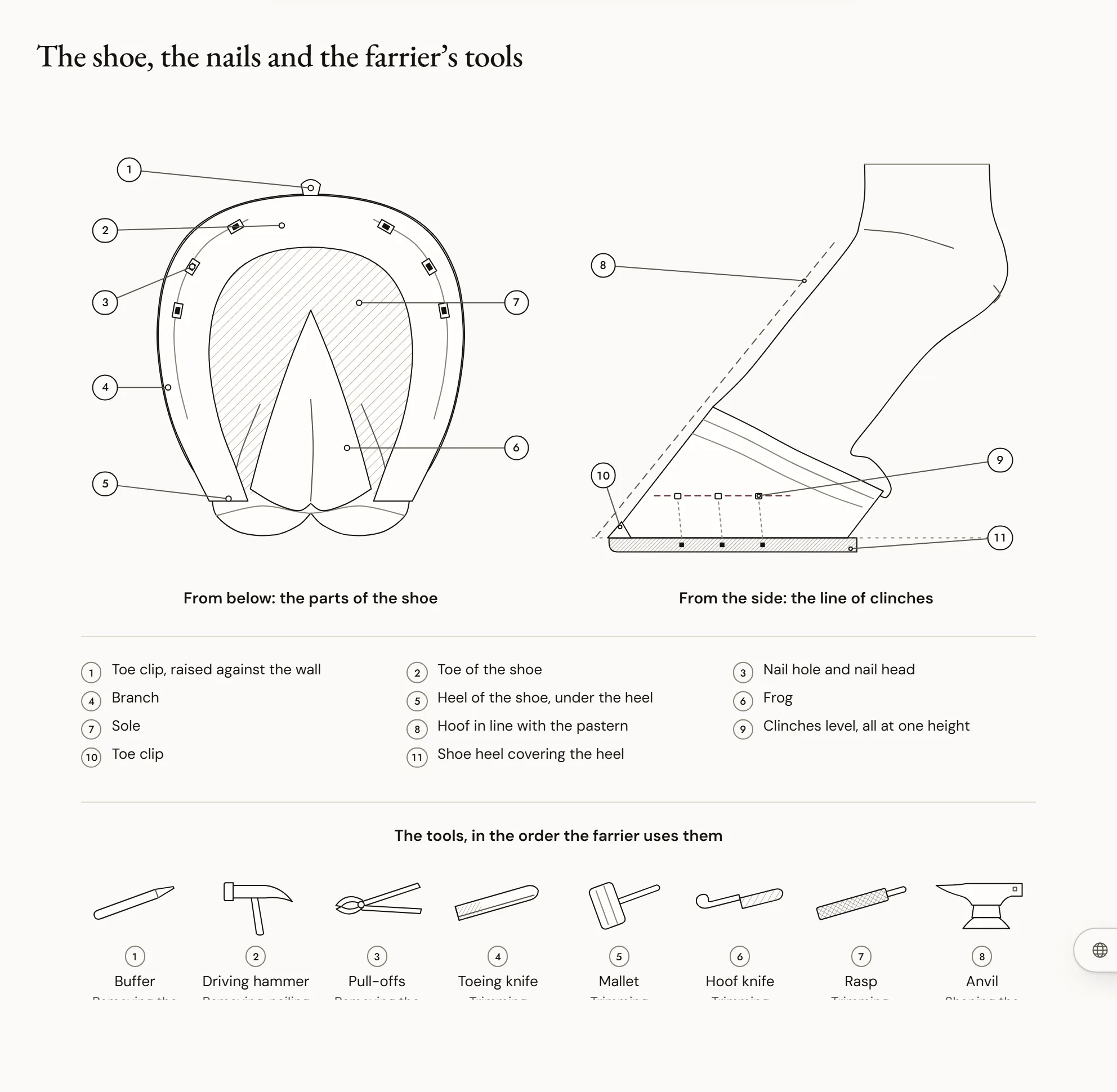
The shoe is a strip of metal nailed under the wall: the toe at the front, the two branches ending in the heels of the shoe, and the nail holes along them. The clip, a small tab drawn up against the wall, stops the shoe sliding back. A horse is well shod when:
- the shoe sits straight under the foot, both branches the same length and lying flat;
- the heels of the shoe cover the horse’s heels, the same distance either side of the frog;
- the clenches are in line at the same height, well turned down and smooth under the hand;
- the foot stays in line with the pastern, with no horn overhanging the shoe.
On average a horse is shod every 6 to 8 weeks; if the shoes are not worn, the farrier does a reset: he takes the shoes off, trims the feet and nails the same shoes back on.
The stages of the farrier’s work
- ObserveThe horse standing, then walked and trotted up in a straight line: how the legs are set, how the shoes have worn, how the foot lands.
- Take off the old shoesKnock up the clenches with the buffer and the driving hammer, then lever the old shoe off with the pull-offs, without tearing the horn.
- TrimTake off the new growth with the toeing knife; clean up sole and frog with the hoof knife; level the bearing surface with the rasp.
- Fit the shoeShape the shoe on the anvil, hot or cold, until it follows the outline of the foot. When hot-shoeing, it smokes, but the wall has no feeling.
- Nail on, cut and clenchDrive the nails: each goes in at the white line and comes out through the wall. Cut off the points, then turn what is left down into clenches.
- Finish and checkA stroke of the rasp smooths the clenches; the farrier has the horse walked to check that it moves well.
Safety
Lame after shoeing
A horse that goes lame just after being shod may have been pricked: a nail has touched the sensitive tissue. Tell the farrier at once; he will take out the nail at fault.
Did you know?
Competition shoes can take screw-in studs for grip on grass. They go in just before the class and come out straight after.
Frequently asked questions
- What are the parts of a horse’s hoof?
- The wall — toe, toe quarters, quarters, heels — with the coronet and periople at the top; underneath, the sole, the frog, the clefts, the bars and the white line; at the back, the bulbs of the heel.
- What is the frog of the hoof for?
- It touches the ground at every stride and, with the digital cushion, absorbs the shock and helps pump blood through the foot. A frog that no longer takes weight cushions badly.
- How often should a horse be shod?
- Every 6 to 8 weeks on average, depending on its work and how fast its horn grows. A barefoot horse needs trimming just as regularly.
- Can a horse go without shoes?
- Yes: many horses do very well barefoot, trimmed regularly, depending on their work, the ground and the quality of their horn.
- Why is my horse lame after shoeing?
- It may have been pricked: a nail has touched the sensitive tissue, or passes too close. Tell the farrier without delay.