The horse skeleton: the bones, from the skull to the phalanges
Under every part of the horse you can name lies a bone or a joint. Knowing the skeleton means understanding why the withers are the high point of the back, why the horse’s knee is not a knee, and what your saddle sits on.
What does a horse’s skeleton do?
An adult horse’s skeleton has about 205 bones. It carries the body, protects the organs — the skull shelters the brain, the rib cage the heart and lungs — and gives the muscles levers to pull on, attached to them by tendons. The bones meet at joints, held together by ligaments.
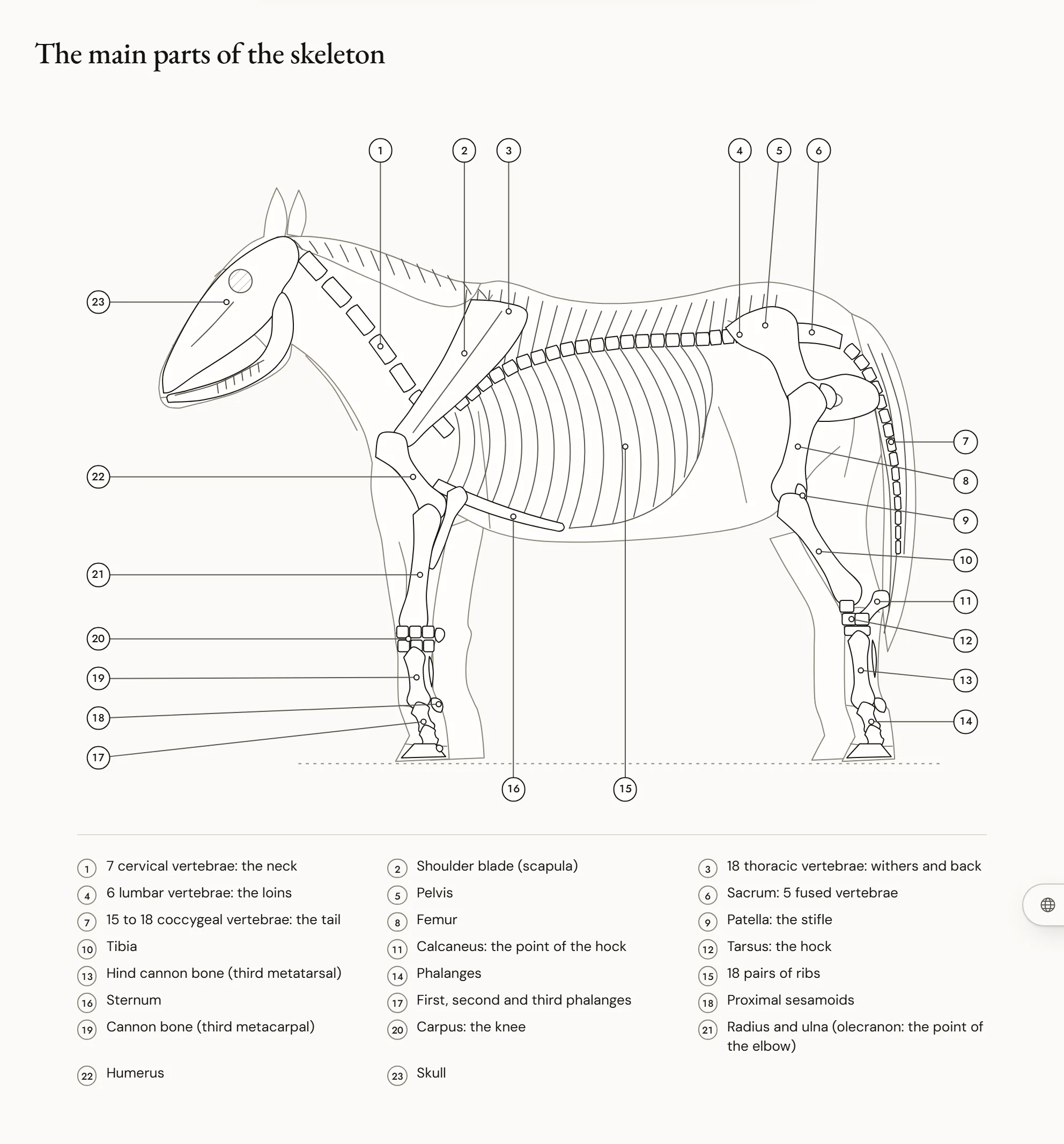
The spine: how many vertebrae?
| Region | Vertebrae | Where to find them |
|---|---|---|
| Cervical | 7 | The neck; the first two are called the atlas and the axis |
| Dorsal (or thoracic) | 18 | The withers and the back; each carries a pair of ribs |
| Lumbar | 6, sometimes 5 | The loins, behind the saddle |
| Sacral | 5, fused | The sacrum, under the croup |
| Coccygeal | 15 to 18 | The tail |
The withers are formed by the long spinous processes of the first dorsal vertebrae: this is the fixed point from which a horse’s height is measured. The 18 pairs of ribs and the sternum form the chest; 8 pairs attach directly to the sternum, the other 10 do not.
Did you know?
Even a horse with an endless neck has only 7 cervical vertebrae — as many as a giraffe, and as many as you.
The bones of the foreleg
- The scapula (shoulder blade) forms the shoulder; its joint with the humerus makes the point of the shoulder.
- The humerus is the bone of the upper arm.
- The radius, the bone of the forearm, is fused to the ulna, whose top, the olecranon, forms the point of the elbow.
- The carpus, seven or eight small bones, is the horse’s “knee”: it corresponds to our wrist.
- The large metacarpal is the cannon bone; two small metacarpals, the splint bones, lie alongside it.
- At the fetlock, the two proximal sesamoids; then the first phalanx (long pastern bone), the second phalanx (short pastern bone) and the third phalanx (pedal bone, inside the hoof), with the navicular bone behind it.
Did you know?
The horse has no collarbone. Its forehand is not attached to the trunk by any bone: the chest hangs between the two shoulders in muscle and ligament, like a hammock.
The bones of the hind leg
- The hip bone, which makes up the pelvis, joins the ilium (point of the hip), the ischium (point of the buttock) and the pubis.
- The femur is the thigh bone; the patella sits at the front of the stifle.
- The tibia is the bone of the gaskin; the fibula, much reduced, is fused to it.
- The tarsus — the hock — has six or seven small bones, including the talus and the calcaneus, which forms the point of the hock.
- The large metatarsal (the hind cannon) and its splint bones, then the sesamoids and the phalanges, as in the foreleg.
Remember
The horse’s knee = the carpus, our wrist. The hock = the tarsus, our ankle. Below the knee and the hock, the horse walks on the equivalent of a single finger.
What the skeleton explains in the saddle
The saddle and the back
The saddle rests either side of the dorsal vertebrae, never on them: that is why a saddle must clear the withers and the spine.
The loins, a weak spot
The lumbar vertebrae have no ribs to support them: you sit on the back, not on the loins.
The foot, a finger
The pedal bone sits inside the hoof: the horse’s whole weight rests on it, slung in its box of horn.
Frequently asked questions
- How many bones does a horse have?
- About 205 bones in an adult. The number varies slightly from one horse to another, mostly in the tail.
- How many vertebrae does a horse have?
- 7 cervical, 18 dorsal, 6 (sometimes 5) lumbar, 5 fused sacral and 15 to 18 coccygeal vertebrae in the tail.
- Does a horse have a collarbone?
- No. Its forehand is joined to the trunk only by muscles and ligaments: the chest hangs between the two shoulders.
- What does a horse’s knee correspond to?
- Our wrist: it is the carpus. The hock corresponds to our ankle.
- What is the bone inside a horse’s hoof?
- The third phalanx, or pedal bone, with the navicular bone just behind it.