Horse coat colours: recognising every colour, from bay to tobiano
The coat colour is the colour of the horse: his coat, his mane and tail, and his skin. There are dozens, but they are all named with the same method, by looking in the right places. From the three basic colours to pied and spotted coats, here is how to recognise them without a mistake — and why there is no such thing as a “ginger” horse.
The method: body, mane and tail, points
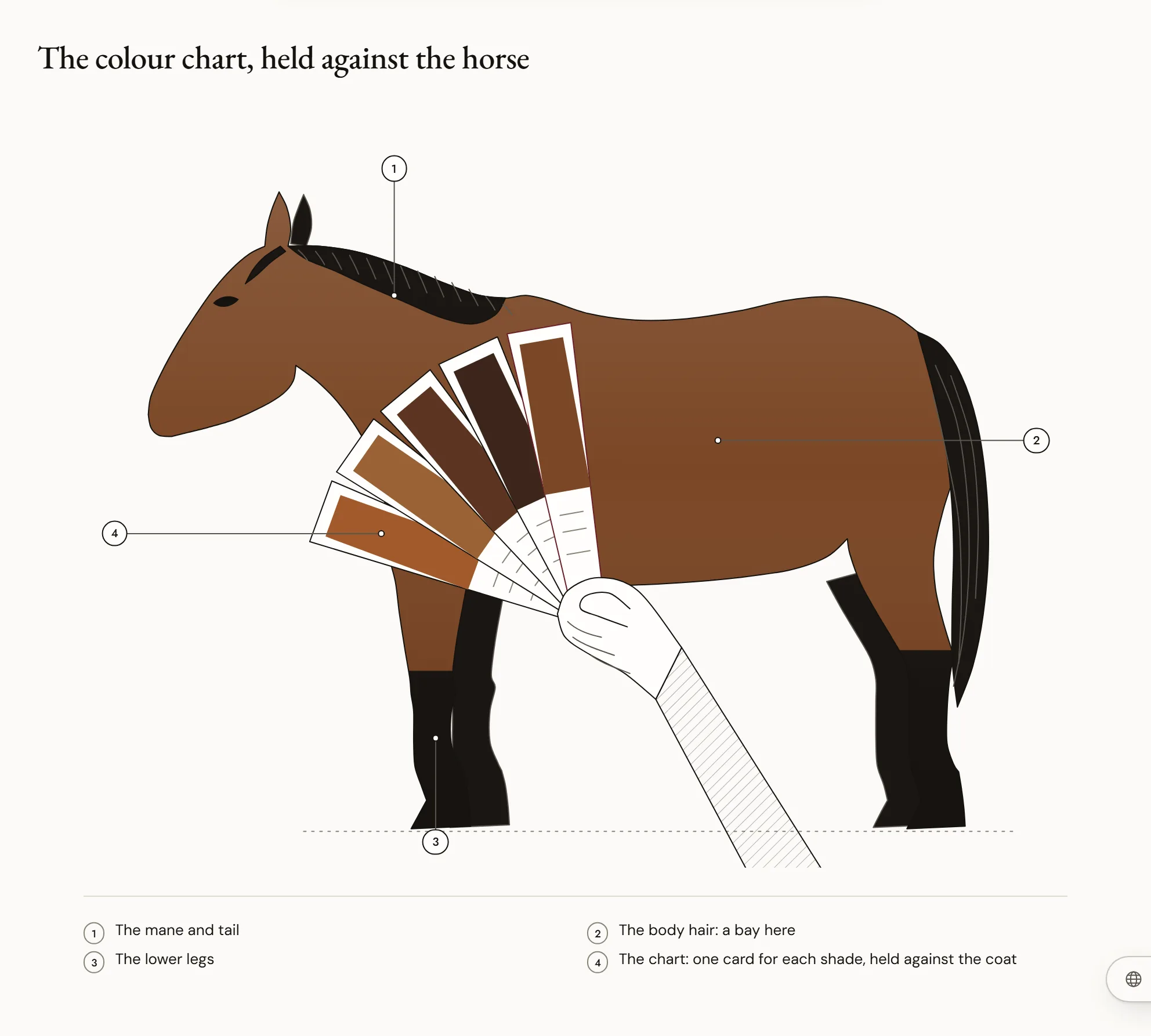
To name a colour, always look at three things, in this order: the colour of the body hair, the colour of the mane and tail, and the colour of the points — the lower legs and the rims of the ears. For the light coats, two more clues come in: the colour of the skin, which shows around the eyes, nostrils and mouth, and the colour of the eyes.
Did you know?
Foals often change colour as they grow, and the winter coat is duller than the summer one. To name a coat colour with certainty, look at an adult horse, in the sun, with a clean coat.
The three basic colours: black, chestnut, bay
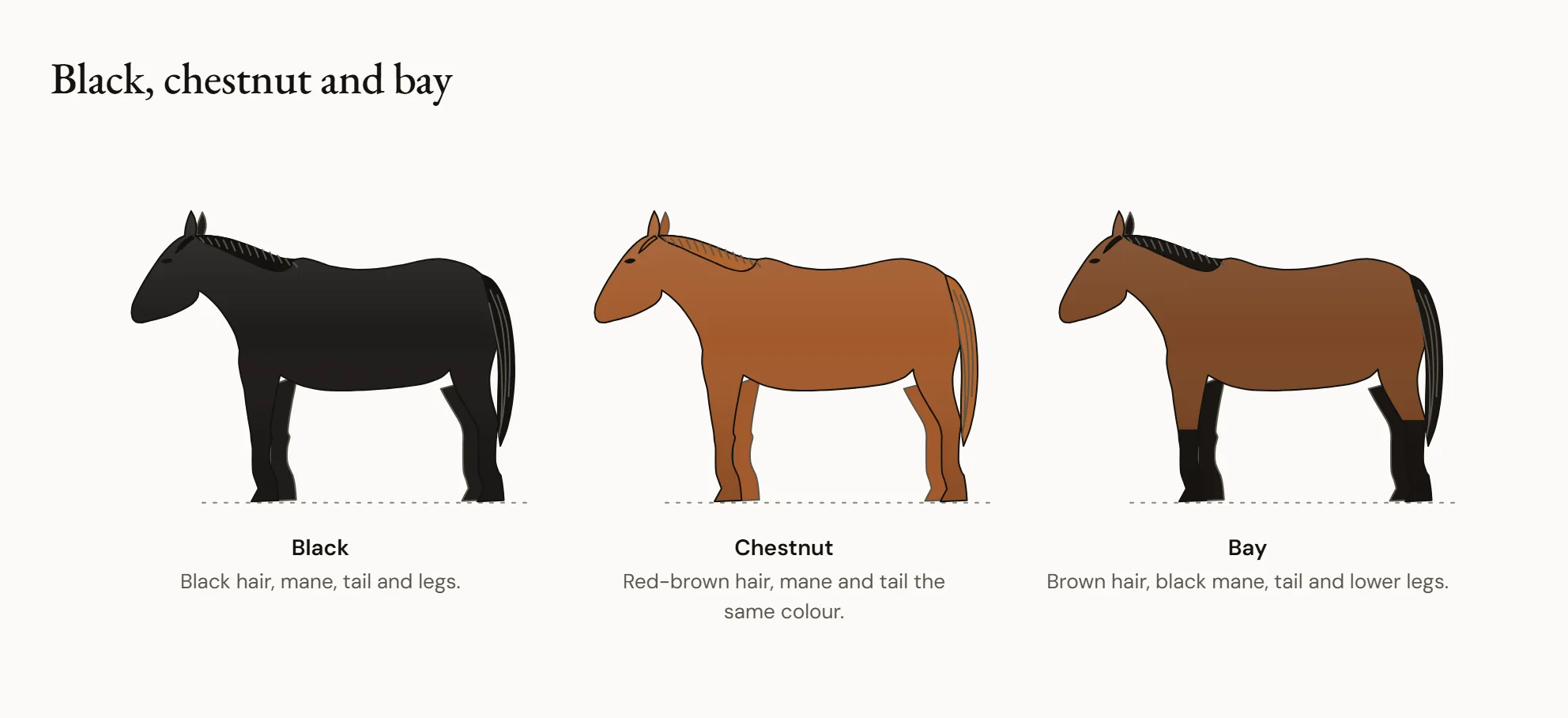
| Colour | Body | Mane and tail | Lower legs |
|---|---|---|---|
| Black | Black | Black | Black |
| Chestnut | Reddish, light to dark | Like the body, or lighter | Like the body |
| Bay | Brown to reddish | Black | Black |
Remember
A black mane and tail on a brown body: that is a bay. A mane and tail the colour of the body: that is a chestnut.
Common mistake
A very dark chestnut can look brown, almost bay. Look at his tail and his lower legs: if there is not a single black hair, he is a chestnut.
The other colours: white, grey, cream and chocolate
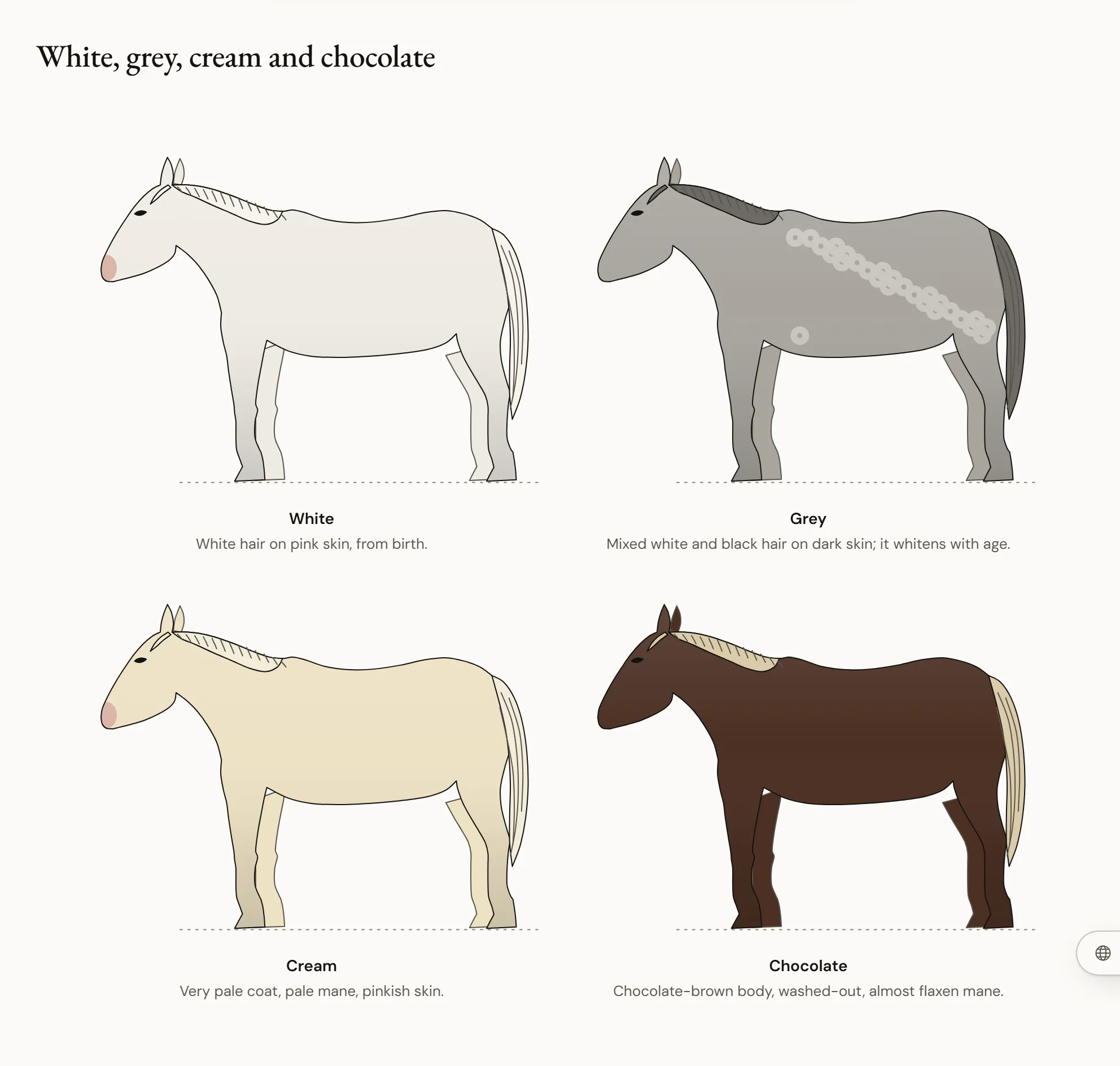
- White
- White hair, mane and tail, pink skin all over, dark eyes. The horse is born white and stays white all its life: it is a very rare colour.
- Grey
- A mixture of white and coloured hairs, black skin. A grey is born dark and lightens with age: an old grey can look completely white.
- Cream
- Off-white hair, a white to greyish mane and tail, pink skin and pale eyes, often blue.
- Chocolate
- A very dark chocolate-brown body with a washed-out, almost flaxen mane and tail: that contrast is what gives it away.
Remember
An all-white horse with black skin is a grey. A true white has pink skin. Look around the eyes and nostrils before you answer.
The bay family and the chestnut family
Bay and chestnut each have a family: lighter, darker or more golden coats that keep the mane-and-tail rule. Black mane and tail: the bay family. Never black: the chestnut family.
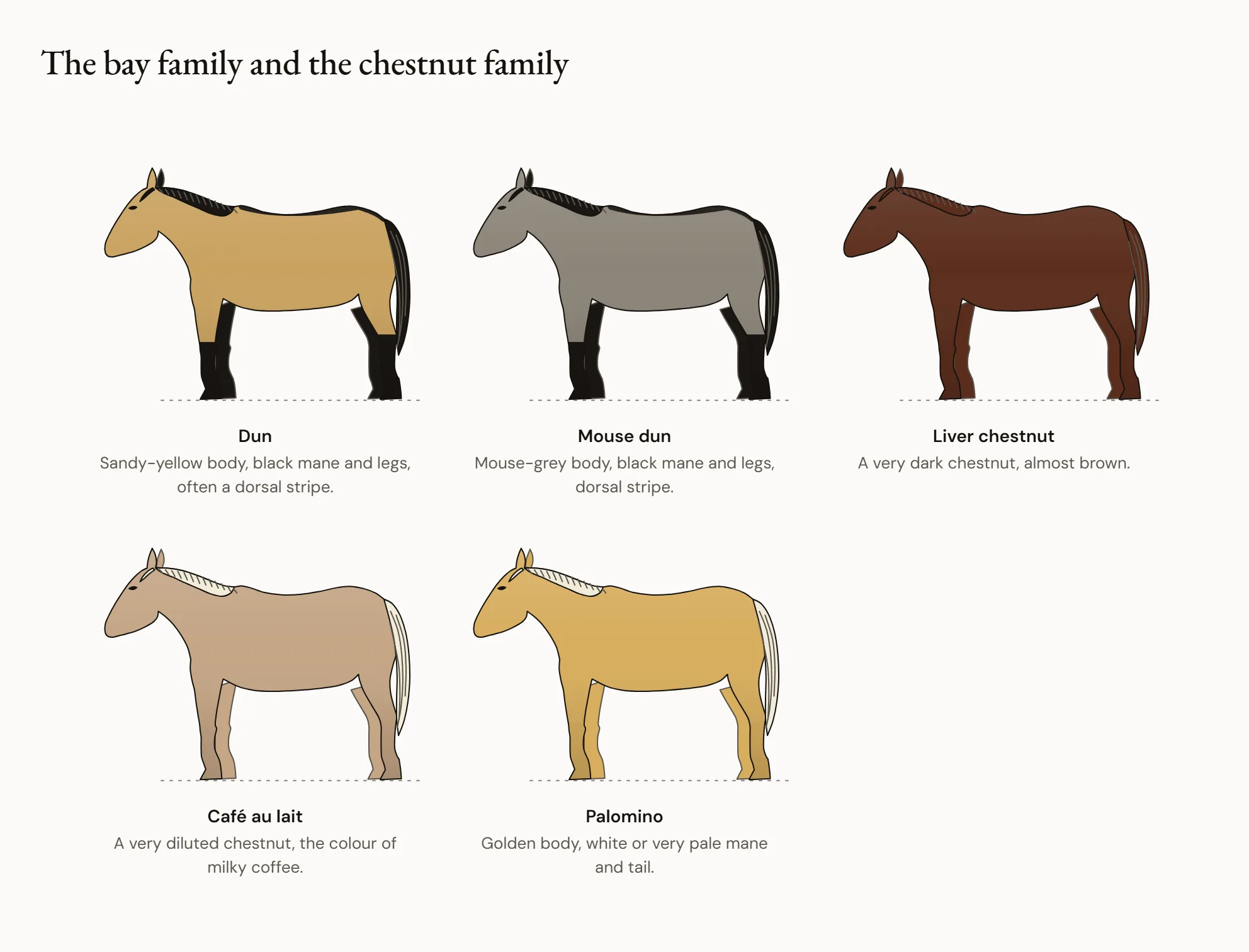
Bay family
Dun
Yellowish hair, from pale yellow to fawn, with a black mane, tail and points. Often a dorsal stripe along the back.
Bay family
Mouse dun
Ash-grey hair, all one shade, black points. A dorsal stripe and zebra marks on the legs are common.
Chestnut family
Liver chestnut
Very dark, the colour of roasted coffee; in the sun, red glints give the chestnut away.
Chestnut family
Palomino
Golden hair and a silvery-white mane and tail; dark skin, never pink; dark eyes, never blue.
| Coat | Not to be confused with | What sets it apart |
|---|---|---|
| Dun | Palomino | A black mane and tail; the palomino’s are white. |
| Mouse dun | Grey | Solid hair with no white hairs mixed in; a grey turns whiter with age, a mouse dun does not. |
| Café au lait | Palomino | A mane and tail the same colour as the body. |
| Palomino, café au lait | Cream | Dark skin and dark eyes; the cream has pink skin and often blue eyes. |
Pied coats: tobiano, overo, tovero, balzan, sabino
A horse is pied when it has large white patches with pink skin underneath. You first name the colour of the coloured patches, then add “pie”: black pie (a piebald), chestnut pie or bay pie (skewbalds). The official nomenclature then names the pattern, from the head, the legs, the topline and the edges of the patches.
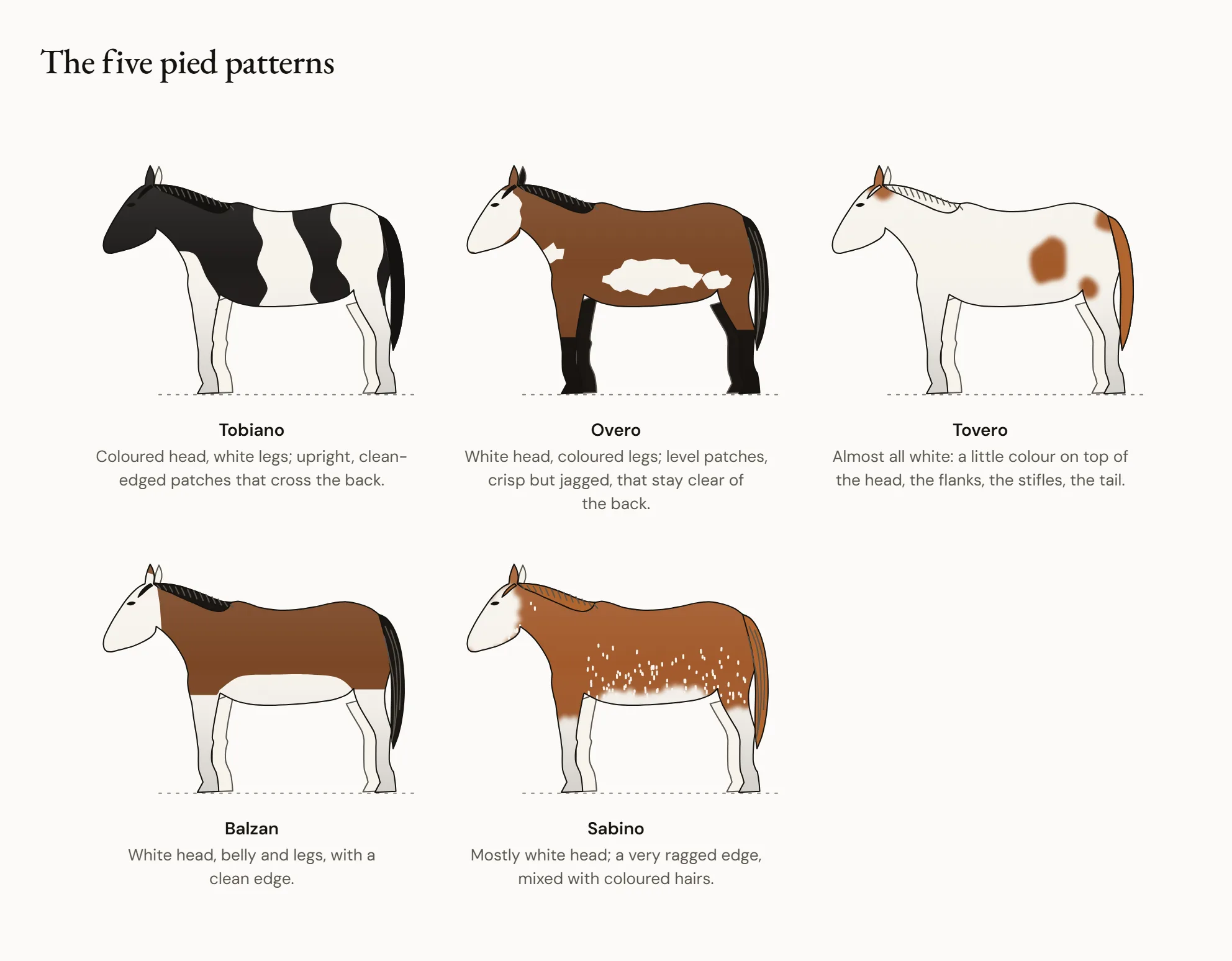
| Pattern | Head | White patches |
|---|---|---|
| Tobiano | Mostly coloured | Mostly upright, crisp edges; at least one crosses the topline |
| Overo | Mostly white | Mostly horizontal; none touches the topline |
| Tovero | White, often coloured at the top | Almost the whole body; a few coloured areas remain |
| Balzan | White | Head, belly and legs; crisp, even edges |
| Sabino | Mostly white | Very irregular, ragged edges, mixed with coloured hairs |
Did you know?
The word “pie” comes from the magpie, a black-and-white bird — pie in French. English keeps it in piebald.
Spotted coats: leopard, blanket, marbled…
Spotted coats mix small white and coloured spots. They are best known in the Appaloosa, but occur in other breeds too. These horses often have mottled skin round the eyes and muzzle, plenty of white showing round the eye, and striped hooves.
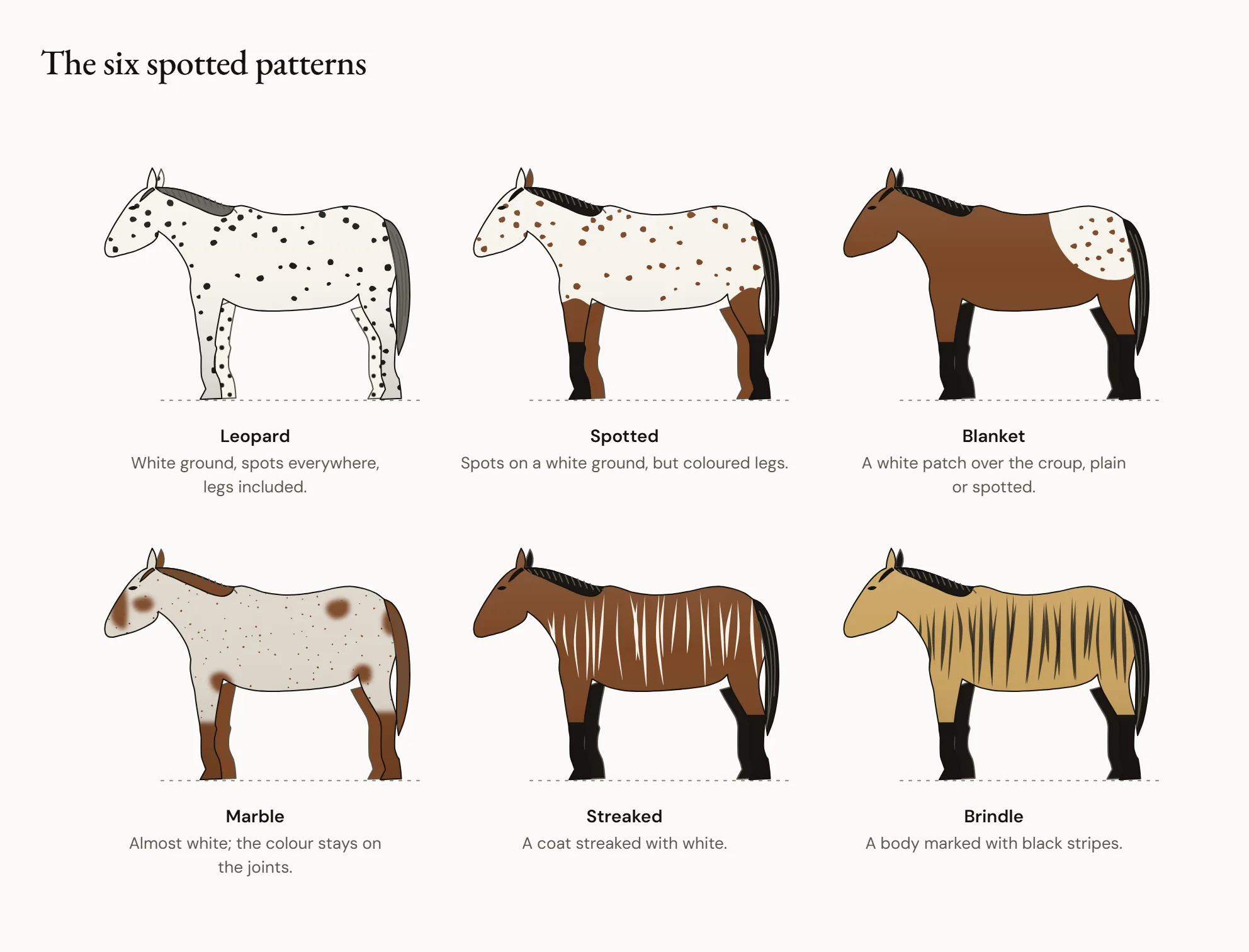
- Leopard
- A white ground covered in coloured spots over the whole body, legs included.
- Spotted
- Coloured spots on white, but coloured legs.
- Blanket
- A white patch covers at least the croup, plain or scattered with spots.
- Marbled
- A coat overrun by white hairs; colour survives only on the joints.
- Streaked and brindle
- White streaks for the streaked horse, black stripes for the brindle.
Common mistake
Calling a horse scattered with small spots a “pie”. A pie has large patches; small spots make a spotted horse.
The additions: dorsal stripe, dapples, flaxen mane
Additions are laid on top of the coat without changing it. They finish making a horse unique and appear in its description.
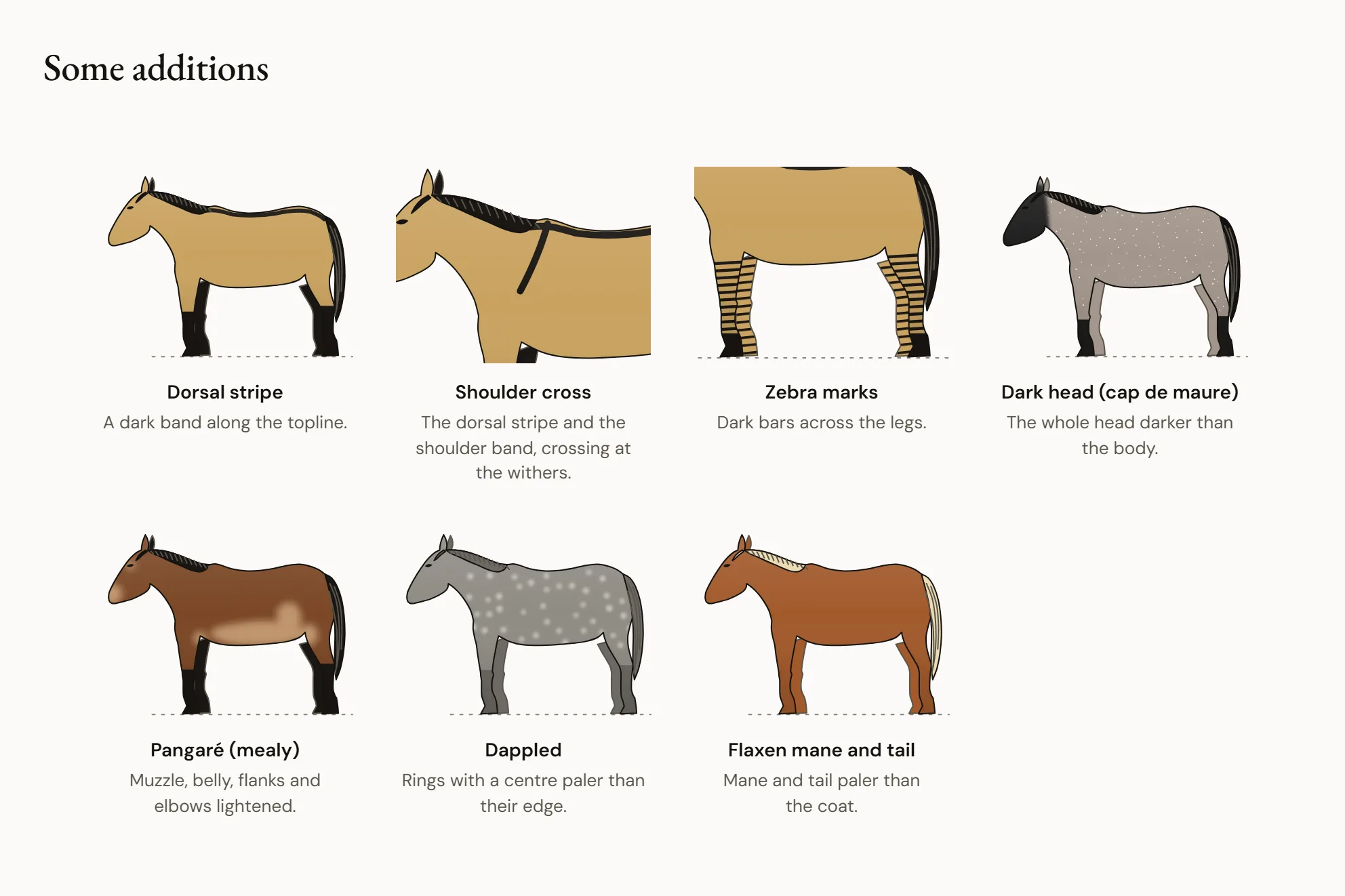
- Darker hairs: the dorsal stripe along the topline, the cross over the withers, zebra marks on the legs, the moor’s head.
- Lighter hairs: the pangaré or mealy effect, which lightens the muzzle and flanks; the dappled coat, scattered with rings paler in the middle.
- Mane and tail: flaxen, paler than the coat; silver; or mixed.
- Skin: champagne skin, pink freckled with tiny dark spots.
A word from the instructor
Roll a skewbald in the mud and you have a bay for the afternoon. The examiner would rather wait until after the hosepipe.
Naming a horse’s colour like an identifier
For the identity document, the colour is named in steps, in this order: the base colour, any mixture of hairs, any white patterning — pied or spotted — and last the additions: bay tobiano, chestnut with a flaxen mane. The identifier uses the IFCE’s colour chart, held against the horse in daylight.
Common mistake
Naming the colour of a clipped horse, a wet one or one in the middle of moulting. The colour of the coat changes with the seasons; the mane and tail, the skin and the points are far less misleading.
Frequently asked questions
- What is the difference between a bay and a chestnut horse?
- Look at the mane, tail and lower legs: a bay has a black mane, tail and points, a chestnut never does — its mane and tail match the body, or are lighter.
- Is a white horse always white?
- Hardly ever: most white horses are greys that have whitened with age. A grey has black skin; a true white has pink skin all over.
- What is the difference between pied and spotted?
- A pied horse carries large white patches on pink skin; a spotted horse is scattered with small spots, like the Appaloosa.
- Is there such a thing as a brown horse?
- In the yard, a brown horse with a black mane and tail is a bay, and a reddish one with a matching mane and tail is a chestnut; very dark, it is a liver chestnut or a chocolate.
- At which Galop do you learn coat colours?
- The three basic colours at Galop 1, the other colours and patches at Galop 2, the bay and chestnut families at Galop 3, and pied and spotted patterns and additions at Galop 5.