Horse white markings: star, blaze, socks, stockings and whorls
Two horses of the same colour are told apart by their white markings and their whorls. These features do not change with age: named properly, they let you pick a horse out of a hundred. Here is the official vocabulary, from a trace of white to a white face, and the method to describe a horse without missing a thing.
What is a white marking?
A white marking is an area of white hair, usually on pink skin, on the head or the lower legs. It does not change the coat colour: a chestnut with a broad blaze is still a chestnut. The official vocabulary, that of the French horse and riding institute (IFCE), describes each marking by its position, its shape and its extent.
Head markings: star, stripe, blaze, white face
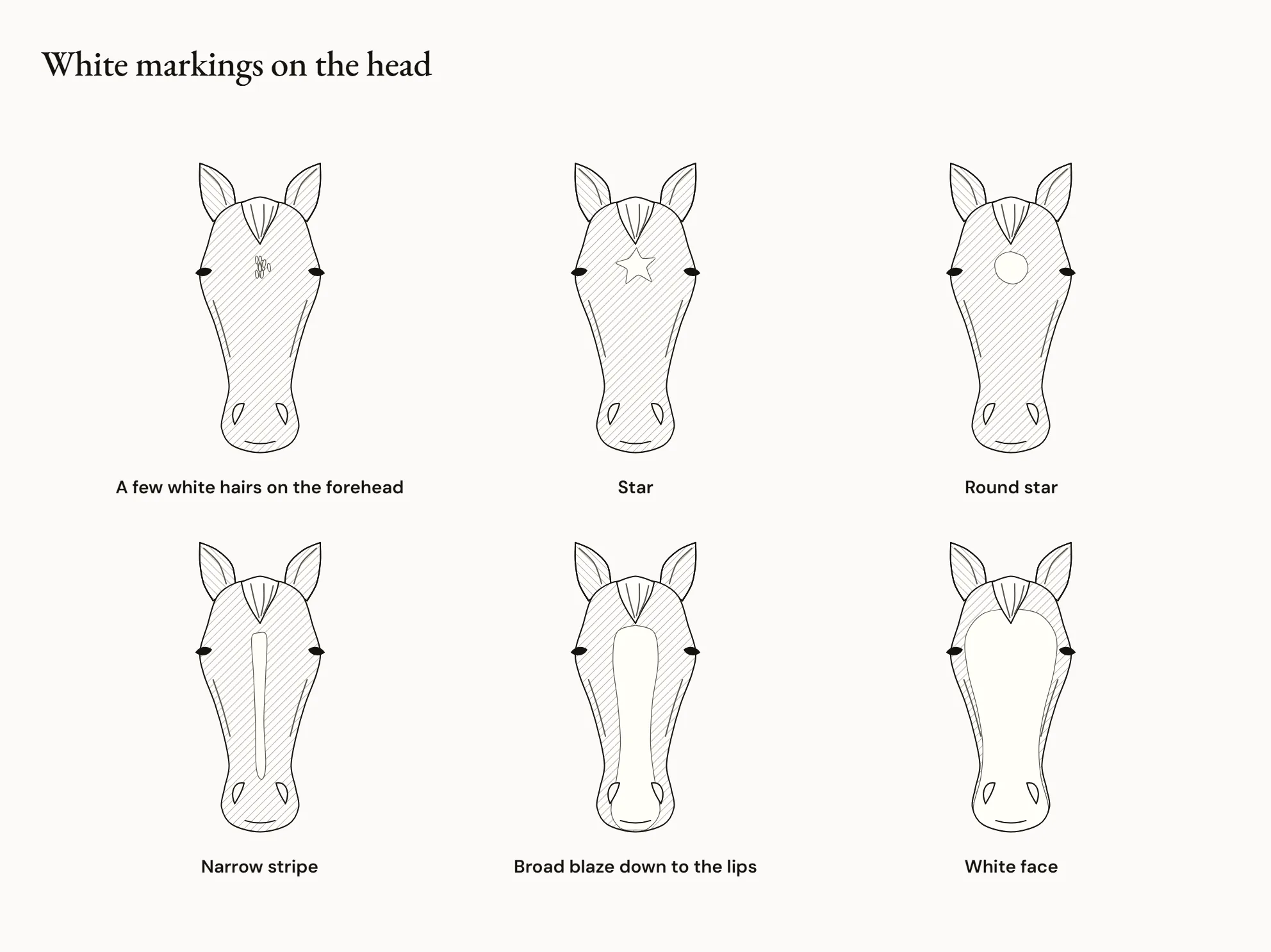
- Star
- A white marking on the forehead. You state its size and shape: a few white hairs, a star proper, a crescent, a diamond, an oval — or a round one, which French calls a pelote.
- Stripe or blaze
- A vertical white band down the face. A narrow one is a stripe, a broad one a blaze; it can be straight or crooked, continuous or broken.
- Drinks in its white
- The French way of describing a horse whose blaze runs right down to its lips: it dips its white in the water every time it drinks.
- White face
- A very broad blaze that spreads onto the sides of the head.
Markings often come together: a star can run on into a stripe down the face, and then you describe both, in order, from the forehead to the muzzle.
Leg markings: from a trace of white to a high stocking
A leg marking is white on the lower leg that starts at the hoof. It is named after the height where the white stops.
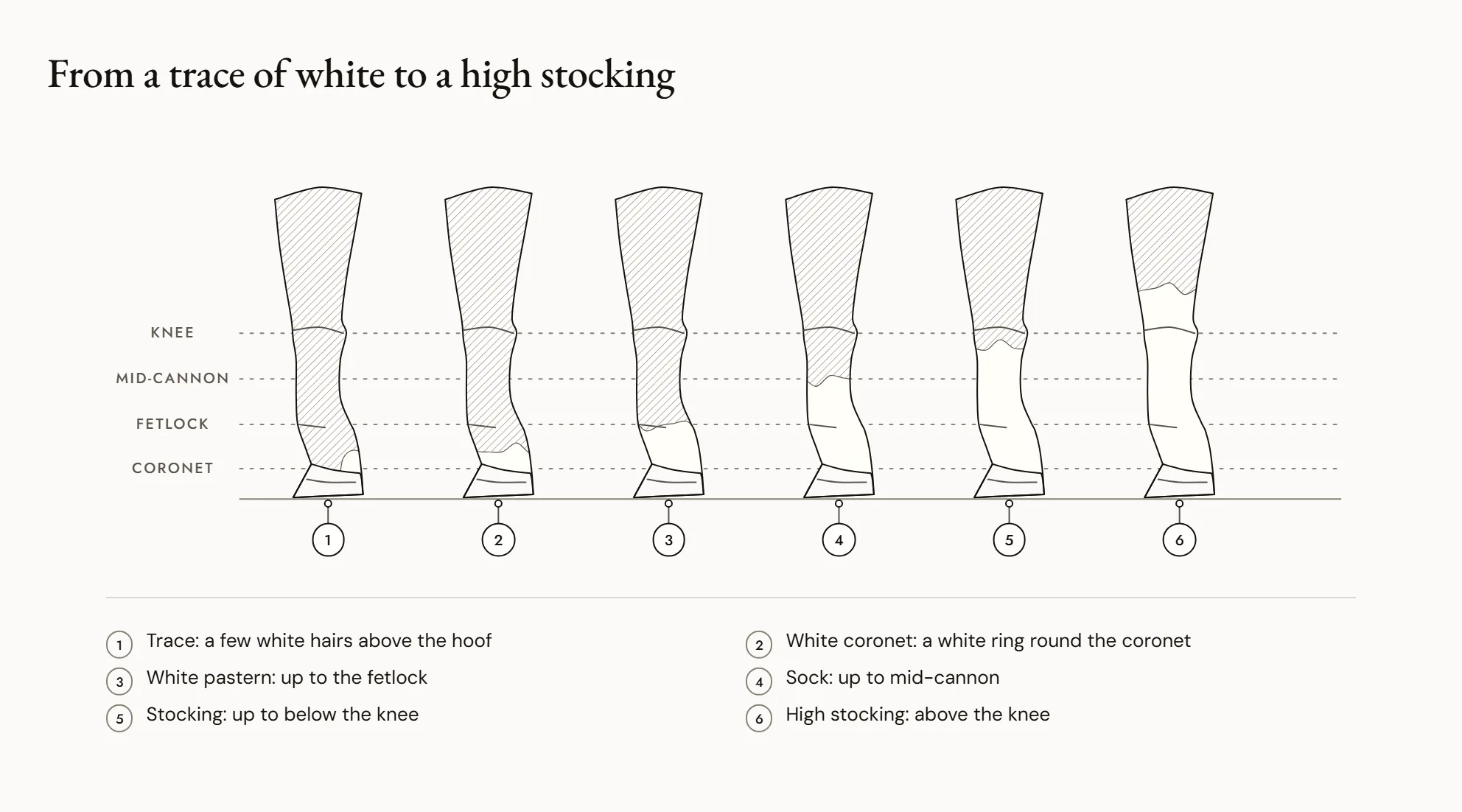
| Name | How far up the white goes |
|---|---|
| Trace of white | A few white hairs above the hoof that do not go all the way round the leg. |
| White coronet | A white ring all the way round the leg just above the hoof, no higher than the pastern. |
| White pastern | Up to about the fetlock, pastern included. |
| Sock | Up to about the middle of the cannon. |
| Stocking | Above the middle of the cannon, to just below the knee or the hock. |
| High stocking | Up to the knee or the hock, or beyond. |
Remember
To describe a leg marking precisely, say which leg it is on and where it stops: “left fore, sock to mid-cannon”, for instance. A leg only ever has one leg marking.
Whorls: a horse’s fingerprints
A whorl is a point in the coat around which the hair grows in a swirl: it spreads out from a centre or meets around it, like a cowlick in a person’s hair. You find it more easily by running your hand against the lie of the coat, or in low, raking light.
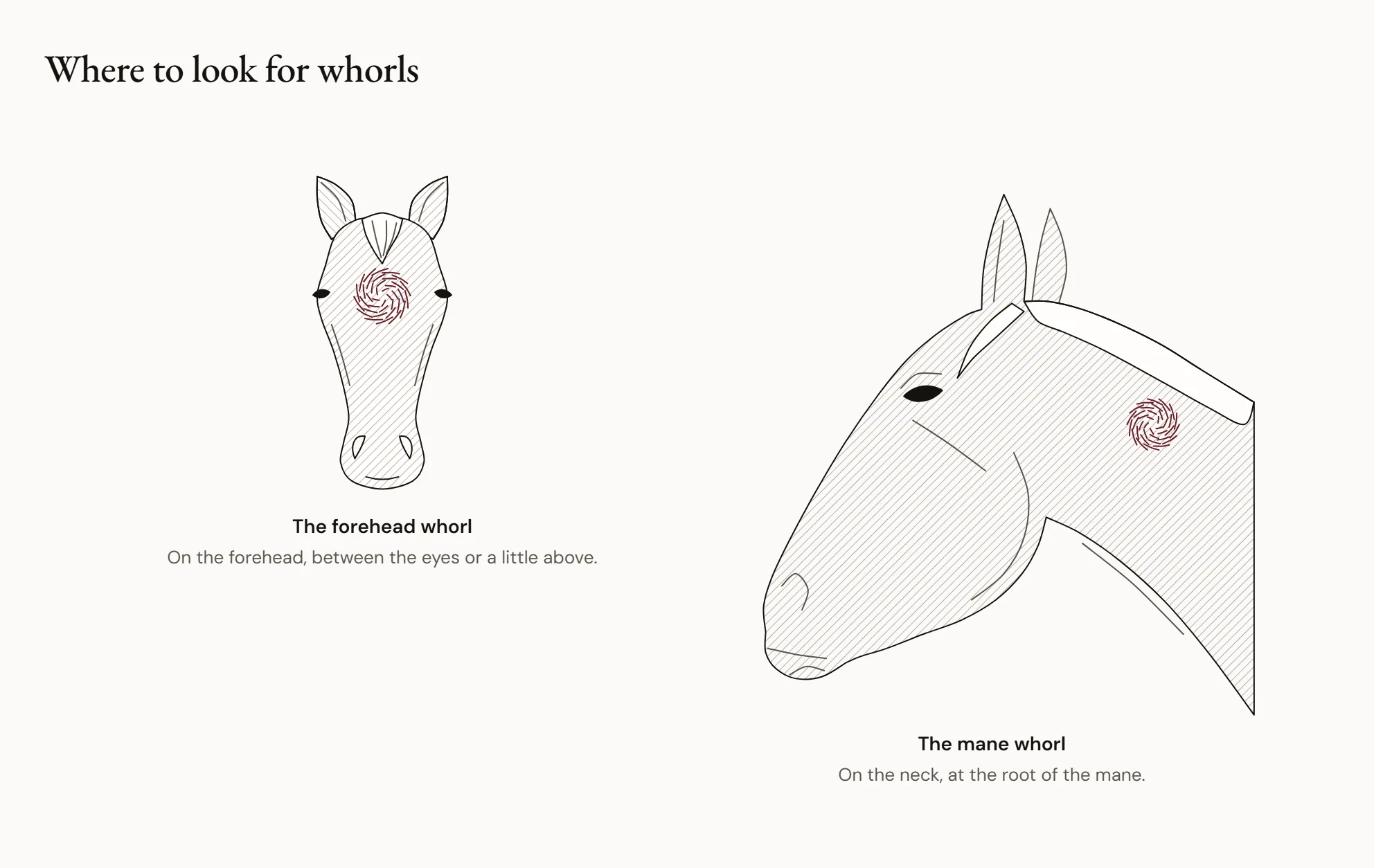
- The head whorl is on the forehead, usually between the eyes or a little above. The great majority of horses have at least one; some have two or three.
- The mane whorl is on the neck, at the root of the mane or along its edge, on one side or the other.
- Other whorls grow on the chest, the belly or the lower neck: they are recorded too when a horse is identified.
A word from the instructor
A horse can change its rug, its mane and even its name. Its whorls stay in the same place all its life: they are its fingerprints, only hairier.
Describing a horse: the method, in order
Sex, colour, markings and whorls, noted in a fixed order, make up the horse’s description: the record in its papers that lets you check you really have the right horse in front of you.
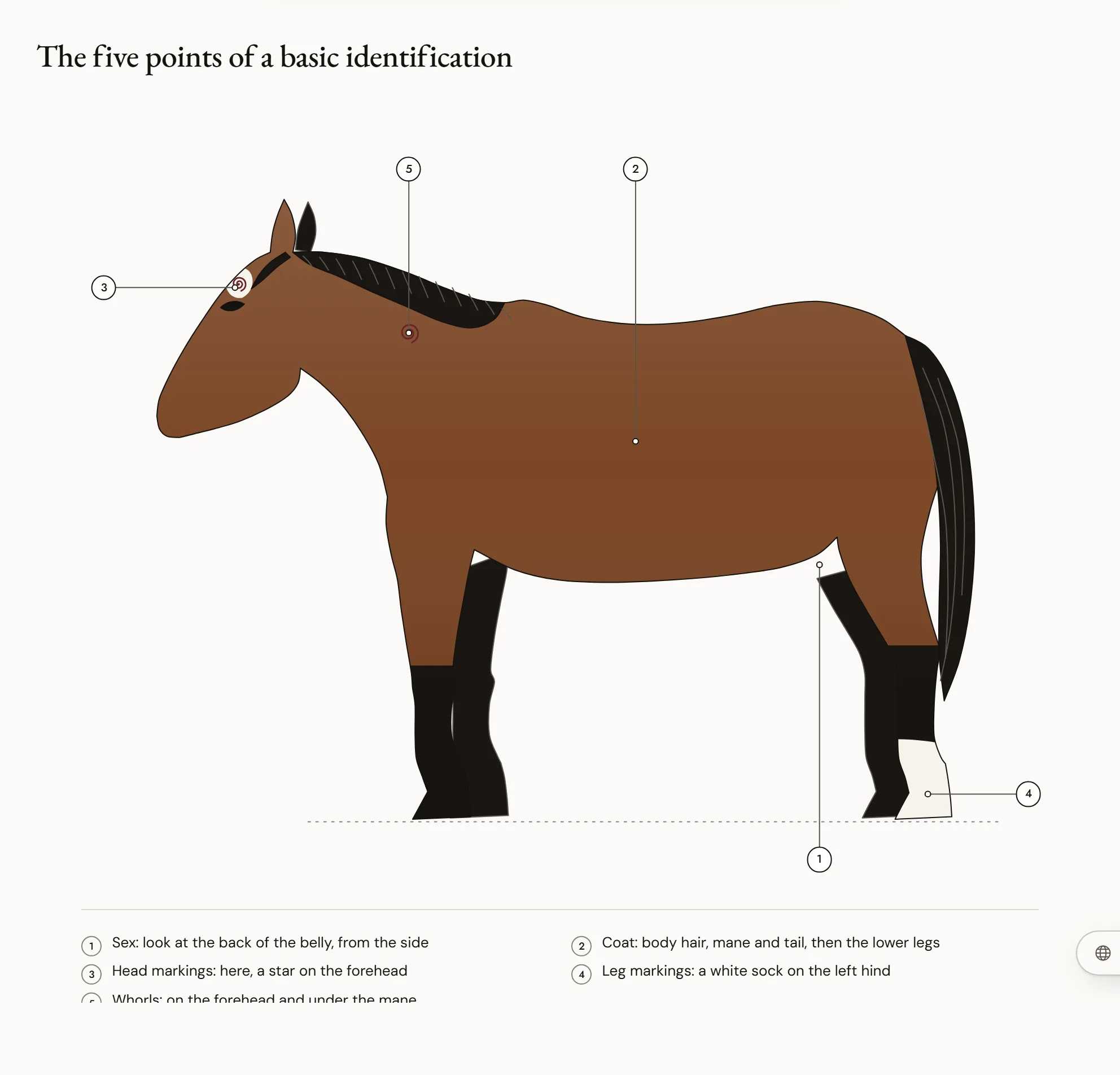
- Set up the observationHorse held on level ground, in good light, clean, dry and without a rug: a wet coat looks darker, a rug hides the markings.
- Sex and colourStallion, gelding or mare, seen from the side; then the colour, from the body coat, the mane and tail and the points.
- Head markingsA star, a blaze, a snip between the nostrils: name each marking, its shape and its size.
- Leg markingsAlways in the same order: near fore, off fore, near hind, off hind. For each marking, note how high the white reaches.
- Whorls and distinguishing marksLook for whorls on the forehead, on both sides of the neck, on the chest; finally note scars and white hairs left by an injury or by tack.
Safety
To check the sex or the hind legs, stay beside the horse, never behind him or crouched under his belly.
A word from the instructor
“He’s got a white bit on his face” will not do: half the yard has one. Precise words exist precisely so that the wrong horse does not go home with the wrong owner.
Frequently asked questions
- What is the difference between a star and a blaze?
- A star sits on the forehead; a stripe or blaze runs down the face. The two often come together, and you then describe one after the other.
- What is a sock on a horse?
- A white marking on the lower leg that reaches about the middle of the cannon. Lower down it is a white coronet or pastern; higher up, a stocking or a high stocking.
- What does “drinks in its white” mean?
- That the horse’s blaze runs right down to its lips: it dips its white marking in the water every time it drinks.
- Can a horse have more than one whorl?
- Yes. Most have at least one on the forehead; some have two or three, and others on the neck, chest or belly. They stay put for the horse’s whole life.
- Do white markings change a horse’s coat colour?
- No: a bay with a broad blaze is still a bay. White markings are added to the colour in the description, without changing it.