Horse digestion: from the mouth to the large intestine
The horse is a herbivore built to eat a little at a time, but almost all the time. Every feeding rule on the yard — forage first, several small feeds, no sudden change — comes from a feature of its digestive tract. Here is the route the food takes, organ by organ.
A grazer that nibbles nearly all the time
In the wild, the horse grazes as it slowly moves along, head down, day and night: 15 to 16 hours a day on average, in a great many small meals. It is not a ruminant: like us, it is monogastric, with a single stomach, and it does not chew the cud. It has to chew its food properly the first time.
- It chooses: with its lips and its sense of smell, it sorts the plants, grazes its favourites down and leaves others alone.
- It avoids its droppings: in the field, it keeps the areas where it eats apart from the areas where it dungs.
- It eats in company: when one horse starts to graze, the others often follow.
- In the stable, it waits for its meals: it knows the times, which is why horses are fed at regular hours.
The mouth: lips, teeth and bars
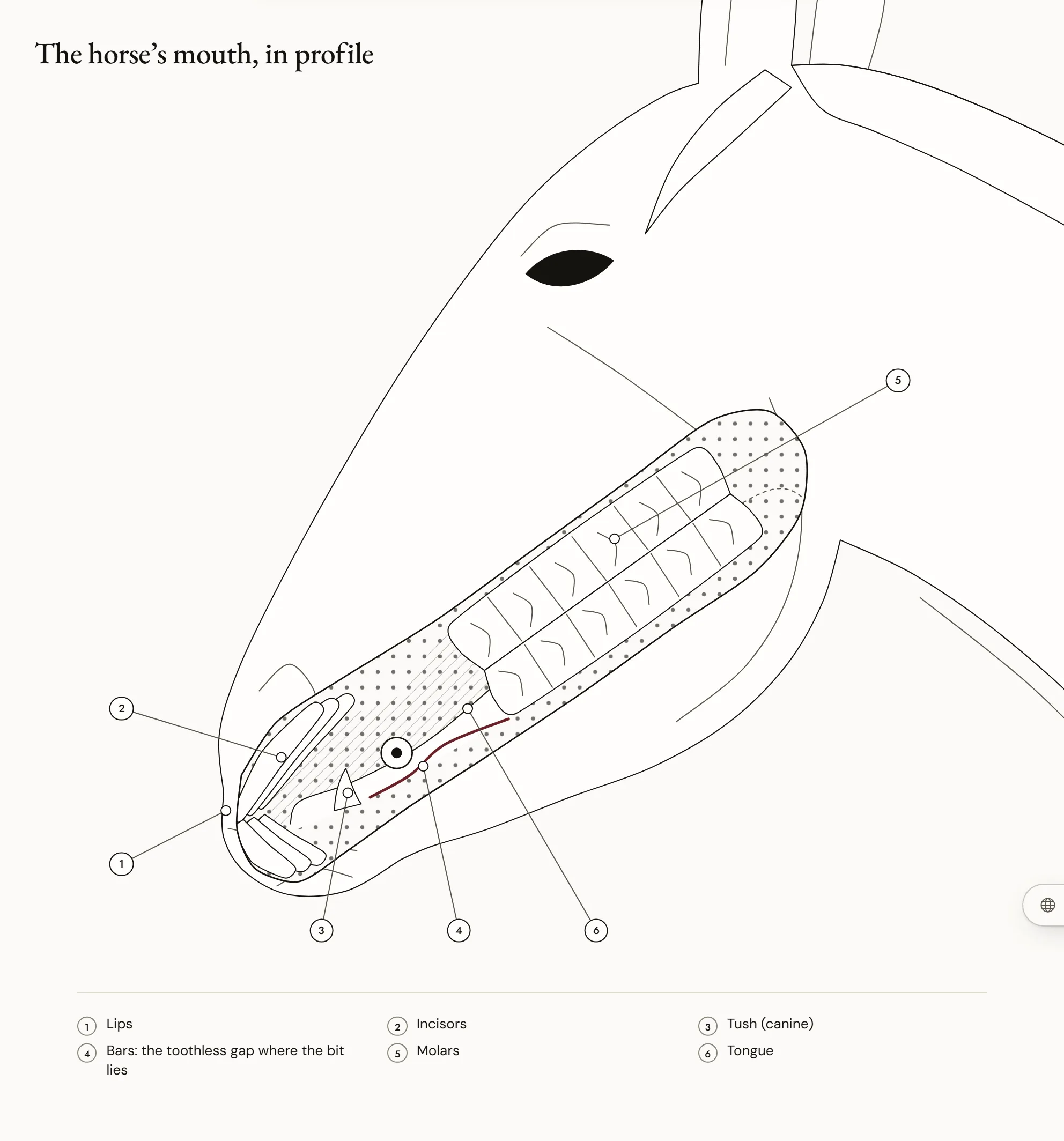
- The lips
- Very mobile and fringed with whiskers: they pick up and sort grass, hay or grain.
- The incisors
- At the front, 6 at the top and 6 at the bottom: they crop the grass close to the ground, like pincers.
- The tushes
- Four small pointed teeth near the incisors. Males have them; mares usually do not.
- The bars
- The toothless gap between the incisors and the molars, where the bit rests. They are very sensitive.
- The molars
- 24 broad, flat teeth, premolars included, that grind the food.
So an adult horse has 40 teeth if it is male and 36 if it is a mare without tushes. Its teeth keep growing for much of its life and wear down as it chews. Hay takes a lot of chewing: about 40 minutes for a kilo, against ten minutes or so for a kilo of pellets.
The route the food takes, organ by organ
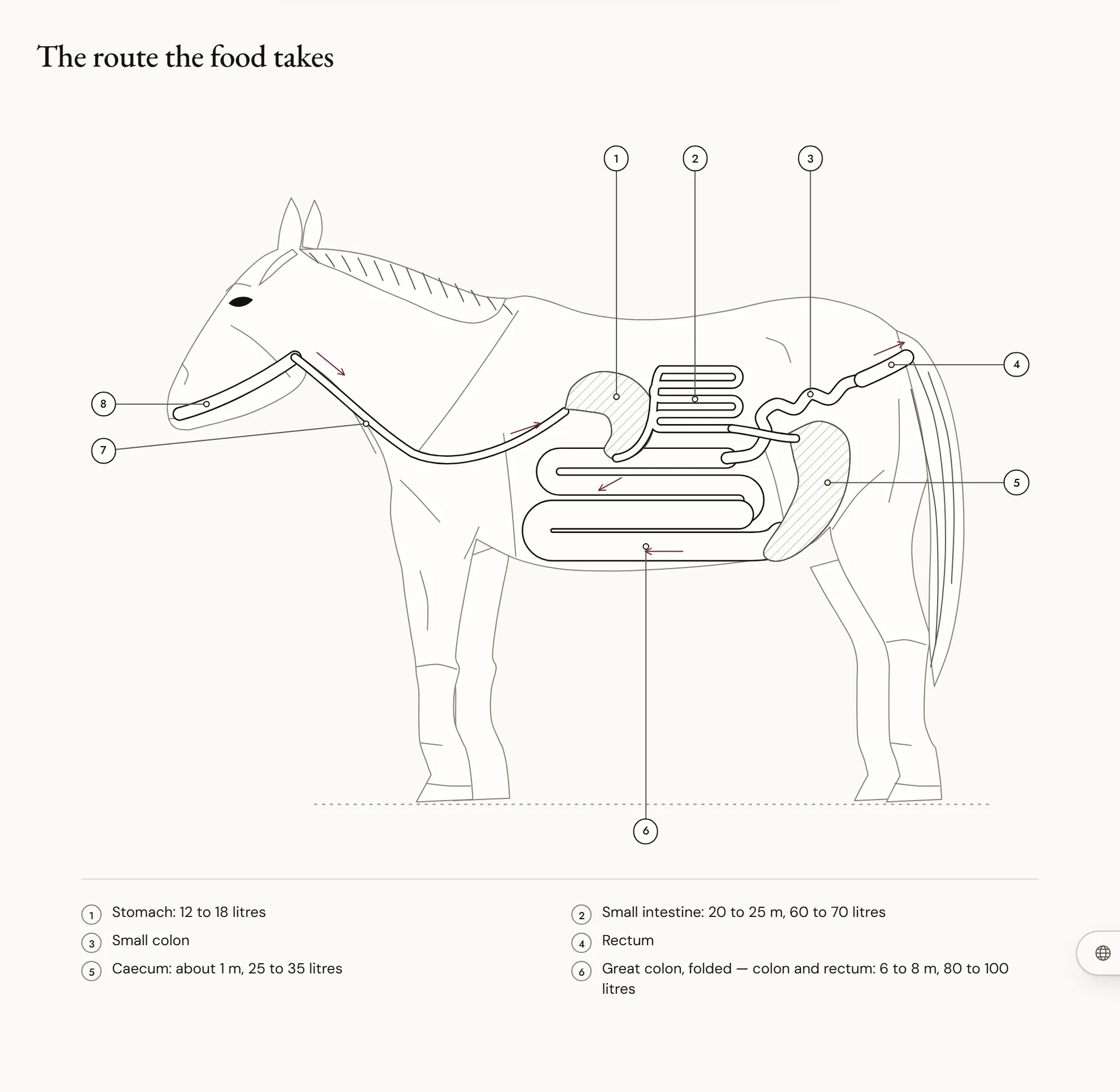
| Organ | Key facts | What happens there |
|---|---|---|
| Oesophagus | A long, narrow tube | It carries food to the stomach; it can block in a greedy horse. |
| Stomach | 12 to 18 litres | Protein digestion begins, 2 to 8 hours. The cardia, at the entrance, stops the horse vomiting. |
| Small intestine | 20 to 25 m, 60 to 70 litres | Enzymes digest starch, fats and proteins; the passage is fast, 1 to 2 hours. |
| Caecum | About 1 m, 25 to 35 litres | A blind-ended pouch where micro-organisms ferment the fibre. |
| Colon and rectum | 6 to 8 m, 80 to 100 litres | Fermentation carries on and water is reabsorbed; 24 to 48 hours in transit. |
Did you know?
The large intestine makes up about 60% of the volume of the digestive tract: it is the large intestine, with its gut flora, that digests the fibre in hay and grass.
What makes a horse’s digestion special
- A small stomach: it copes badly with big meals.
- No vomiting: what goes down must go through. A feeding mistake cannot be undone.
- No gall bladder: bile flows all the time, a sign of a gut made to receive food without a break.
- A fast small intestine: too much hard feed at once rushes through it, and the poorly digested starch ferments in the large intestine.
- A fragile gut flora: the micro-organisms of the caecum adapt to each ration and cope badly with sudden changes.
- A folded colon of varying width, which makes colic more likely, and a mobile small intestine, which can twist.
Safety
Colic, pain in the belly, is the most feared result of a feeding mistake. A restless horse looking round at its flanks, pawing or rolling is an emergency: tell someone in charge and call the vet at once.
What it changes on the yard
- Forage firstHay or grass is the basis of the ration and keeps the horse busy for much of the day.
- Several small feedsHard feed split into several meals rather than one big one.
- Water, hay, grainThe traditional order still makes perfect sense: hay before concentrates.
- No sudden changeAny change of feed is made gradually, over at least a week.
- Watch the droppingsClean water at all times, and an eye on the droppings: how many there are and what they look like tell you how digestion is going.
A word from the instructor
Your horse has a stomach the size of a bucket and a large intestine the size of a bath. Fill the bath first — it’s the one with a taste for hay.
Frequently asked questions
- Is a horse a ruminant?
- No. It is monogastric, with a single stomach, and does not chew the cud. It digests fibre by fermentation in its large intestine, mainly the caecum.
- Why can’t horses vomit?
- The cardia, the muscle that closes the entrance to the stomach, is very strong and prevents anything coming back up. What is swallowed must go all the way through.
- How big is a horse’s stomach?
- Small: 12 to 18 litres for a horse of about 500 kg, against 80 to 100 litres for its colon. Hence the rule of small, frequent meals.
- How many teeth does a horse have?
- An adult male has 40, a mare without tushes 36: 12 incisors, 24 molars and premolars, plus 4 tushes in the male.
- Why feed hay before hard feed?
- Hay fills the stomach and gets digestion going; hard feed then passes more slowly through the small intestine, which limits the fermentation of starch and the risk of colic.