Feeding a horse: the feeds, the needs and the ration
Feeding a horse is not filling a manger: it is meeting its needs with three groups of feed — forage, concentrates, mineral supplements — not forgetting water, in a form its small stomach can cope with. Here are the basic feeds, the quantities to remember, the principles of a good ration and what a feed label really says.
The five basic horse feeds
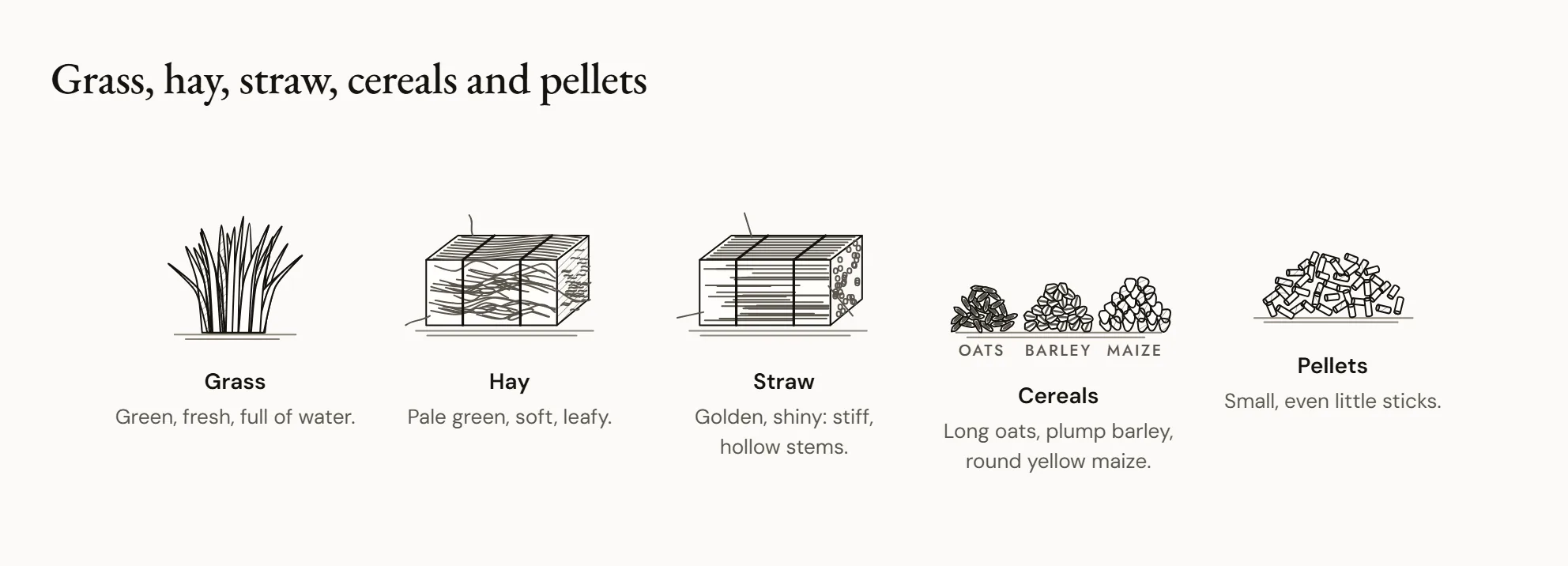
| Feed | What it is | How to recognise it |
|---|---|---|
| Grass | The plants of the field, grazed where they grow. | Green, fresh, full of water. |
| Hay | Grass that has been cut, dried in the sun, then pressed into bales. | Pale green to greenish-yellow, soft, with leaves; a good smell of dry grass. |
| Straw | The stalks of cereal crops once the grain has been harvested. Mostly bedding. | Golden yellow, shiny, hollow, stiff stalks with no leaves. |
| Cereals | Grains — oats, barley, maize — fed whole, rolled or crushed. | Long, pointed oats; plump, hard barley; big, round yellow maize. |
| Pellets | A manufactured feed: plants and grains ground up and pressed into sticks. | Small, even cylinders. |
Tip
Hay or straw? Take a handful. Hay is soft, greenish and smells of grass; straw is yellow, glossy and crackles between your fingers.
The three feed groups and what a horse needs
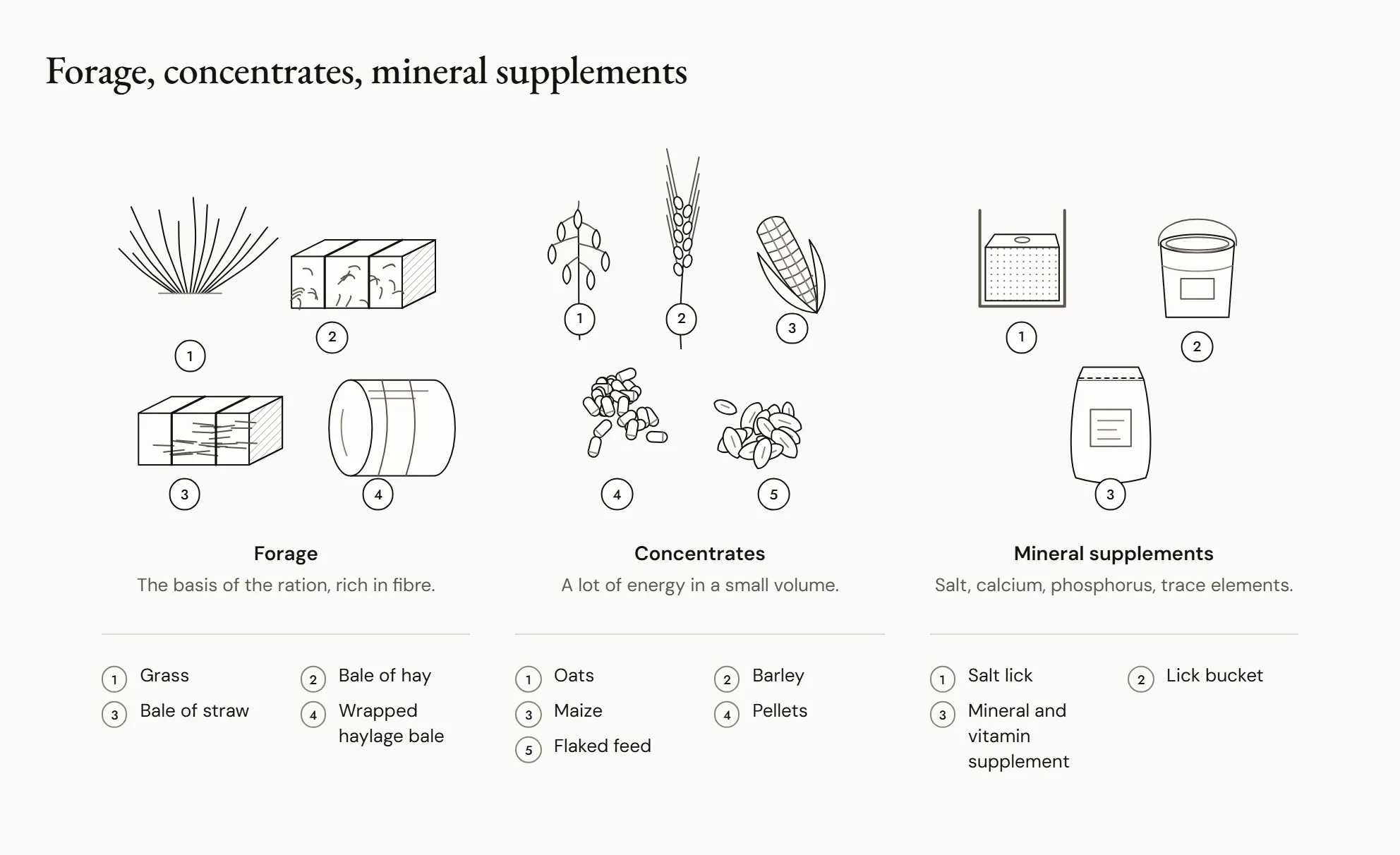
Forage
Grazing, hay, straw, haylage, alfalfa. Rich in fibre, forage is the basis of the diet: at least 1 to 1.5 kg of dry forage per 100 kg of bodyweight a day, which is 5 to 7.5 kg of hay for a 500 kg horse.
Concentrates
Cereals and compound feeds — cubes, flaked mixes. A lot of energy in a small volume, only if the work calls for it, in several small feeds.
Mineral supplements
A salt lick, a lick bucket, a vitamin and mineral supplement. The sodium in salt is lost in sweat; cereals, low in calcium, are balanced with a supplement.
As for water, clean and always available, a horse drinks 20 to 60 litres a day depending on the heat, its work and its diet: a horse grazing young grass drinks less than a horse fed on hay.
Remember
Forage first, and plenty of it; concentrates only if the work calls for them, in small feeds; salt and minerals as a supplement; clean water at all times.
Tip
A litre is not a kilo: a litre of cubes weighs well under a kilogram, and a litre of oats even less. Weigh the yard’s scoop once, so you know what you are really feeding.
Handing out the feed on the yard
- Know the rationEvery horse has its own: which feeds, how much, at what time. Follow the yard’s feed chart and change nothing.
- CheckFeed that is mouldy, damp or dusty is not fed: put it aside and tell someone.
- Feed everyone at onceHay before cereals or cubes; in the field, more piles of hay than there are horses, well spaced out.
- WatchA horse that turns its nose up at its feed or will not drink may be ill: report it.
Safety
Do not work a horse within an hour of a feed of cereals or cubes, and after exercise wait until it is calm and dry before giving it one.
Common mistake
Adding a handful of grain “because he looks hungry”. The ration is worked out for that horse: too much grain can make it ill.
The principles of rationing
Rationing means giving a horse what it needs, no more and no less. Needs are measured in UFC — the French horse feed unit, for energy — and in MADC — digestible crude protein — from the horse’s body weight. A 500 kg riding mare at maintenance needs about 4.1 UFC and 296 g of MADC a day; work, growth or lactation add production requirements on top.
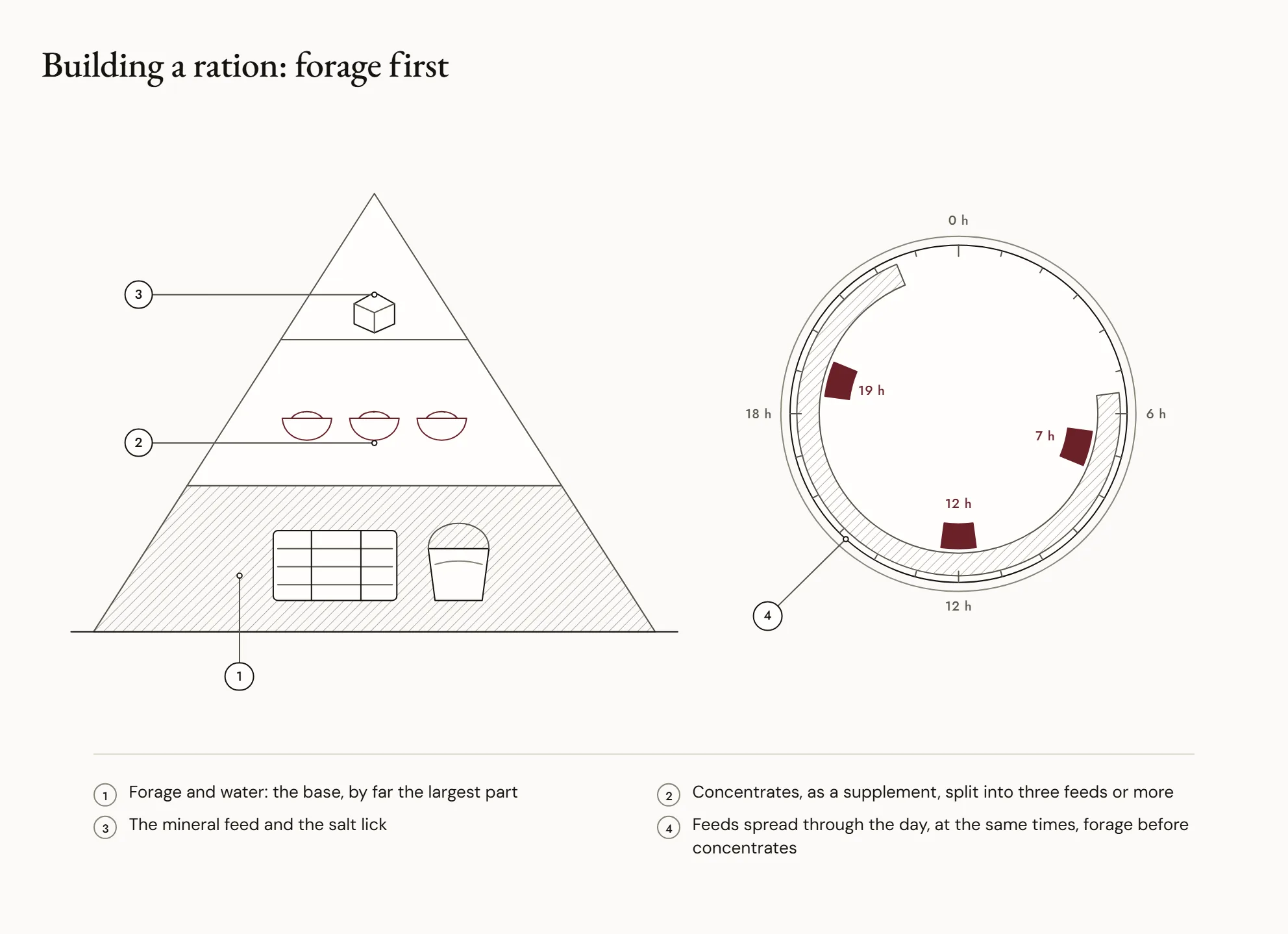
- Forage first: it covers most of the needs and keeps the horse occupied — 40 minutes to eat 1 kg of hay, ten or so for 1 kg of cubes.
- Hard feed as a top-up, according to the work actually done, split into at least three feeds a day.
- Regular times, forage before hard feed.
- Change gradually: over several days for a hard feed, several weeks for a new forage or turning out onto grass.
- Water always available, and salt; a calcium-to-phosphorus ratio between 1.5 and 1.8.
- Wholesome feed: no mould, as little dust as possible.
Safety
On a rest day, cut the hard feed: keeping a competition-day ration invites colic and tying-up.
Reading a feed label
On a feed bag, the words are not chosen at random: European law fixes what they mean. A complete feed is enough for the ration on its own — rare for a horse; a complementary feed only makes up the ration with forage — most cubes and mixes; a mineral feed contains at least 40% crude ash; a dietetic feed serves a specific nutritional purpose, for a limited time.
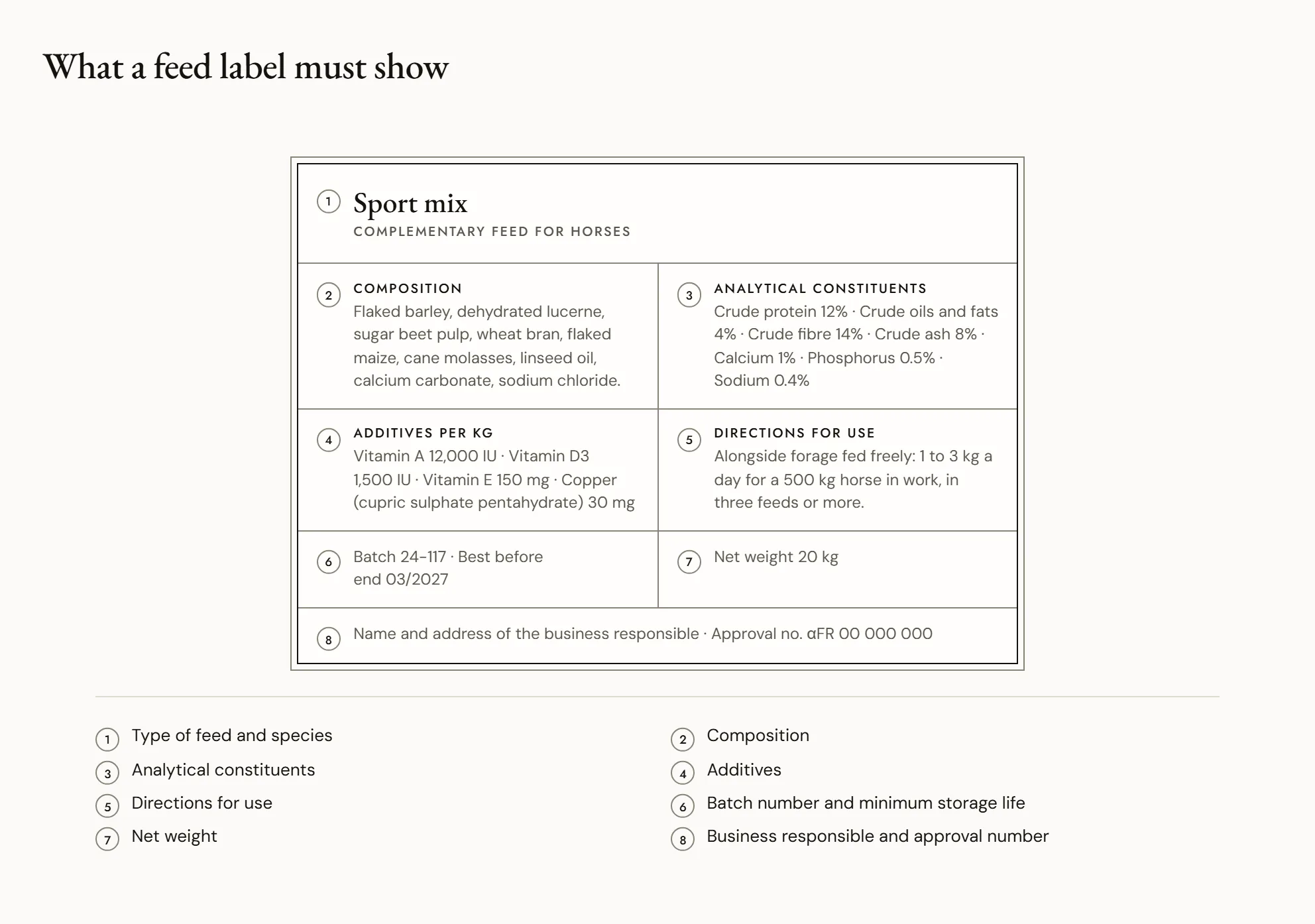
The composition tells you what dominates: if barley or maize come first, the feed is high in starch; if it is alfalfa or beet pulp, it is more fibrous. Stick to the dose in the directions for use, especially for a mineral feed: doubling the dose does not double the benefit.
A word from the instructor
A bag that promises vitality, shine, suppleness and good manners all at once is a bag that talks too much. The legal label on the back is far less poetic — and far more useful.
Frequently asked questions
- How much hay should a horse eat a day?
- At least 1 to 1.5 kg of dry forage per 100 kg of bodyweight, or 5 to 7.5 kg of hay for a 500 kg horse. Good hay is often enough on its own for a horse at rest or in light work.
- How much water does a horse drink a day?
- 20 to 60 litres depending on the heat, the work and the diet; 20 to 40 litres on average. Water must be clean and available at all times.
- Does a horse need cereals?
- Only if forage does not cover its energy needs, mainly those of work, and always in several small feeds. One big feed in one go is a classic cause of colic.
- What is the difference between hay and straw?
- Hay is dried grass: soft, greenish, it feeds the horse. Straw is the stalk of cereal crops: yellow, hollow and stiff, it is mostly used as bedding.
- Why change a horse’s feed gradually?
- Because the flora of its large intestine adapts to each ration and copes badly with sudden changes: several days for a hard feed, several weeks for a new forage.